BR Cross Swing - MACD HistRawThis strategy looks at the MACD Relationship through the same logic but mainly focuses on breaking things down and the application on raw values. อินดิเคเตอร์ Pine Script®โดย L_Wiz2255
Sols Day Trading Signals (5m / 10m)This indicator is designed for day trading on the 5-minute and 10-minute charts. Includes: EMA 9 & EMA 21 crossover signals MACD momentum confirmation RSI trend filter (50+) Buy/Sell labels directly on the chart 💡 How to Use: Go long when EMA 9 crosses above EMA 21, MACD is positive, and RSI is above 50 Go short when EMA 9 crosses below EMA 21, MACD is negative, and RSI is below 50 Best used with proper risk management (1-2% per trade) ⚠️ Disclaimer: This is for educational purposes only — always backtest and trade responsibly.อินดิเคเตอร์ Pine Script®โดย Nanihzx83
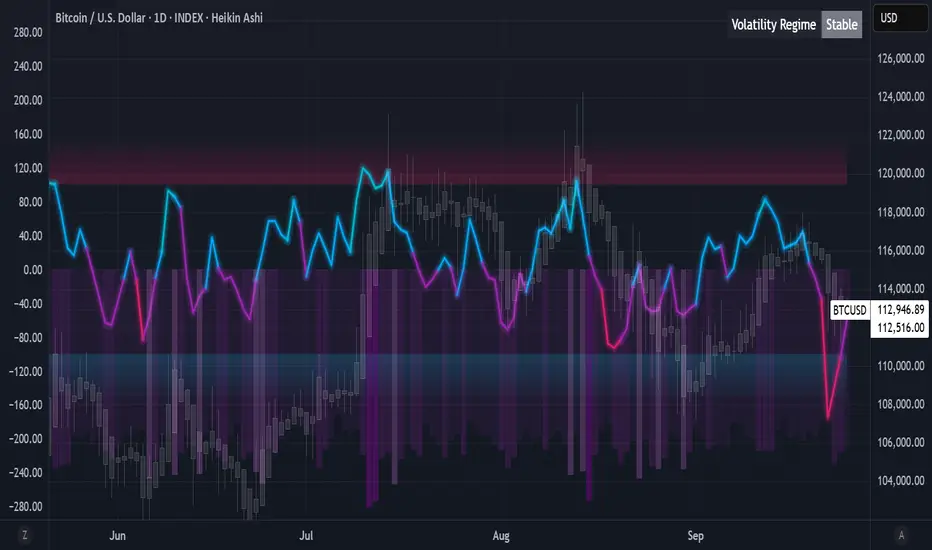
Algorithmic Value Oscillator [CRYPTIK1]Algorithmic Value Oscillator Introduction: What is the AVO? Welcome to the Algorithmic Value Oscillator (AVO), a powerful, modern momentum indicator that reframes the classic "overbought" and "oversold" concept. Instead of relying on a fixed lookback period like a standard RSI, the AVO measures the current price relative to a significant, higher-timeframe Value Zone . This gives you a more contextual and structural understanding of price. The core question it answers is not just "Is the price moving up or down quickly?" but rather, " Where is the current price in relation to its recently established area of value? " This allows traders to identify true "premium" (overbought) and "discount" (oversold) levels with greater accuracy, all presented with a clean, futuristic aesthetic designed for the modern trader. The Core Concept: Price vs. Value The market is constantly trying to find equilibrium. The AVO is built on the principle that the high and low of a significant prior period (like the previous day or week) create a powerful area of perceived value. The Value Zone: The range between the high and low of the selected higher timeframe. Premium Territory (Distribution Zone): When the oscillator moves into the glowing pink/purple zone above +100, it is trading at a premium. Discount Territory (Accumulation Zone): When the oscillator moves into the glowing teal/blue zone below -100, it is trading at a discount. Key Features 1. Glowing Gradient Oscillator: The main oscillator line is a dynamic visual guide to momentum. The line changes color smoothly from light blue to neon teal as bullish momentum increases. It shifts from hot pink to bright purple as bearish momentum increases. Multiple transparent layers create a professional "glow" effect, making the trend easy to see at a glance. 2. Dynamic Volatility Histogram: This histogram at the bottom of the indicator is a custom volatility meter. It has been engineered to be adaptive, ensuring that the visual differences between high and low volatility are always clear and dramatic, no matter your zoom level. It uses a multi-color gradient to visualize the intensity of market volatility. 3. Volatility Regime Dashboard: This simple on-screen table analyzes the histogram and provides a clear, one-word summary of the current market state: Compressing, Stable, or Expanding. How to Use the AVO: Trading Strategies 1. Reversion Trading This is the most direct way to use the indicator. Look for Buys: When the AVO line drops into the teal "Accumulation Zone" (below -100), the price is trading at a discount. Watch for the oscillator to form a bottom and start turning up as a signal that buying pressure is returning. Look for Sells: When the AVO line moves into the pink "Distribution Zone" (above +100), the price is trading at a premium. Watch for the oscillator to form a peak and start turning down as a signal that selling pressure is increasing. 2. Best Practices & Settings Timeframe Synergy: The AVO is most effective when your chart timeframe is lower than your selected "Value Zone Source." For example, if you trade on the 1-hour chart, set your Value Zone to "Previous Day." Confirmation is Key: This indicator provides powerful context, but it should not be used in isolation. Always combine its readings with your primary analysis, such as market structure and support/resistance levels. อินดิเคเตอร์ Pine Script®โดย CRYPTIK1ที่อัปเดต: 3350
Multi Momentum 10/21/42/63 — Histogram + 2xSMAMY MM INDICATOR INDIRED BY KARADI It averages four rate-of-change snapshots of price, all anchored at today’s close. If “Show as %” is on, the value is multiplied by 100. Each term is a simple momentum/ROC over a different lookback. Combining 10, 21, 42, 63 bars blends short, medium, and intermediate horizons into one number. Positive MM → average upward pressure across those horizons; negative MM → average downward pressure. Why those lengths? They roughly stack into ~2× progression (10→21≈2×10, 21→42=2×21, 63≈1.5×42). That creates a “multi-scale” momentum that’s less noisy than a single fast ROC but more responsive than a long ROC alone. How to read the panel Gray histogram = raw Multi-Momentum value each bar. SMA Fast/Slow lines (defaults 12 & 26 over the MM values) = smoothing of the histogram to show the trend of momentum itself. Typical signals Zero-line context: Above 0 → bullish momentum regime on average. Below 0 → bearish regime. Crosses of SMA Fast & Slow: momentum trend shifts (fast above slow = improving momentum; fast below slow = deteriorating). Histogram vs SMA lines: widening distance suggests strengthening momentum; narrowing suggests momentum is fading. Divergences: price makes a new high/low but MM doesn’t → potential exhaustion. Compared to a classic ROC A single ROC(20) is very sensitive to that one window. MM averages several windows, smoothing idiosyncrasies (e.g., a one-off spike 21 bars ago) and reducing “lookback luck.” Settings & customization Lookbacks (10/21/42/63): you can tweak for your asset/timeframe; the idea is to mix short→medium horizons. Percent vs raw ratio: percent is easier to compare across symbols. SMA lengths: shorter = more reactive but choppier; longer = smoother but slower. Practical tips Use regime + signal: trade longs primarily when MM>0 and fast SMA>slow SMA; consider shorts when MM<0 and fastอินดิเคเตอร์ Pine Script®โดย yoni771510
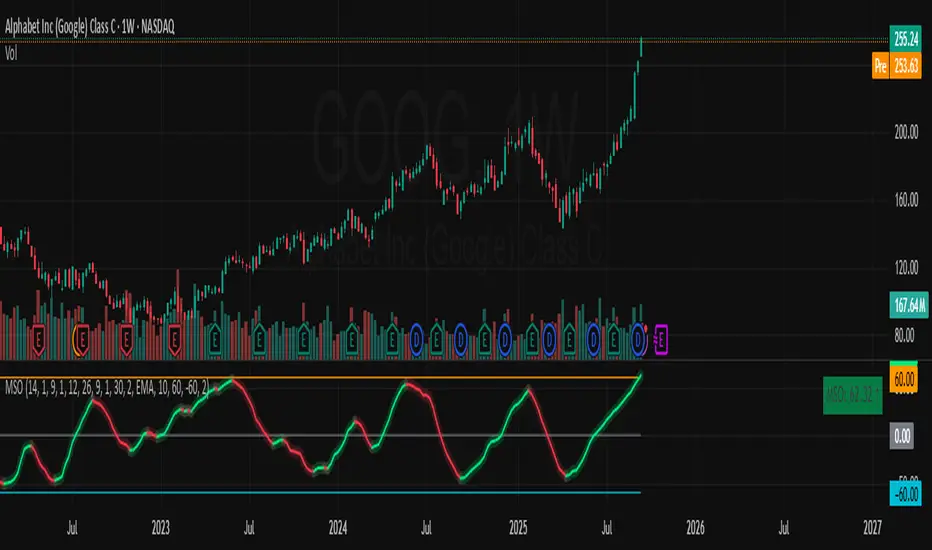
Momentum Shift Oscillator (MSO) [SharpStrat]Momentum Shift Oscillator (MSO) The Momentum Shift Oscillator (MSO) is a custom-built oscillator that combines the best parts of RSI, ROC, and MACD into one clean, powerful indicator. Its goal is to identify when momentum shifts are happening in the market, filtering out noise that a single momentum tool might miss. Why MSO? Most traders rely on just one momentum indicator like RSI, MACD, or ROC. Each has strengths, but also weaknesses: RSI → great for overbought/oversold, but often lags in strong trends. ROC (Rate of Change) → captures price velocity, but can be too noisy. MACD Histogram → shows trend strength shifts, but reacts slowly at times. By blending all three (with adjustable weights), MSO gives a balanced view of momentum. It captures trend strength, velocity, and exhaustion in one oscillator. How MSO Works Inputs: RSI, ROC, and MACD Histogram are calculated with user-defined lengths. Each is normalized (so they share the same scale of -100 to +100). You can set weights for RSI, ROC, and MACD to emphasize different components. The components are blended into a single oscillator value. Smoothing (SMA, EMA, or WMA) is applied. MSO plots as a smooth line, color-coded by slope (green rising, red falling). Overbought and oversold levels are plotted (default: +60 / -60). A zero line helps identify bullish vs bearish momentum shifts. How to trade with MSO Zero line crossovers → crossing above zero suggests bullish momentum; crossing below zero suggests bearish momentum. Overbought and oversold zones → values above +60 may indicate exhaustion in bullish moves; values below -60 may signal exhaustion in bearish moves. Slope of the line → a rising line shows strengthening momentum, while a falling line signals fading momentum. Divergences → if price makes new highs or lows but MSO does not, it can point to a possible reversal. Why MSO is Unique Combines trend + momentum + velocity into one view. Filters noise better than standalone RSI/MACD. Adapts to both trend-following and mean-reversion styles. Can be used across any timeframe for confirmation. อินดิเคเตอร์ Pine Script®โดย SharpStrat203
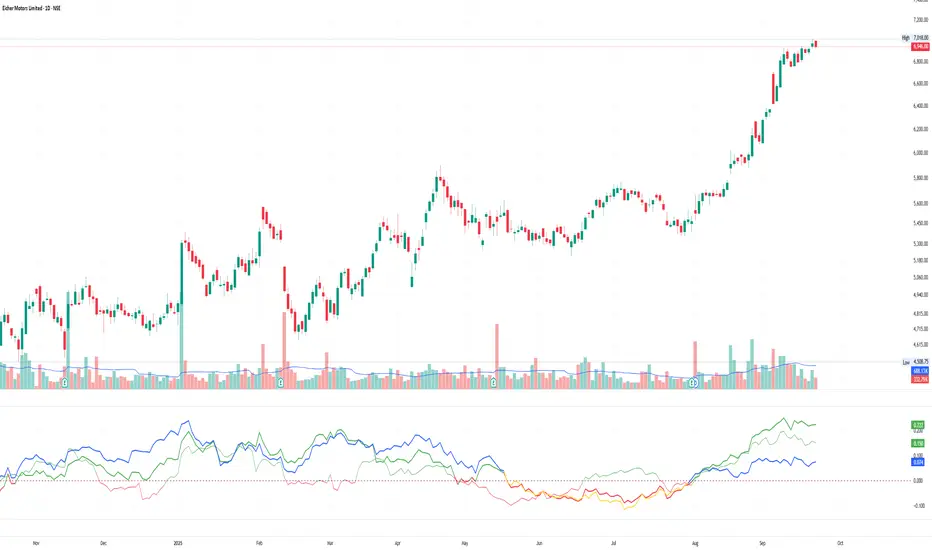
Multiple Relative Strength IndicatorThis indicator is used to display multiple Relative strength of a stock compared with another. Default value for the first Relative strength period is 55 Default value for the second Relative strength period is 21 Default value for the comparable Index is CNX500 You can add the sectorial index for sector comparisonอินดิเคเตอร์ Pine Script®โดย jibutomsที่อัปเดต: 1142
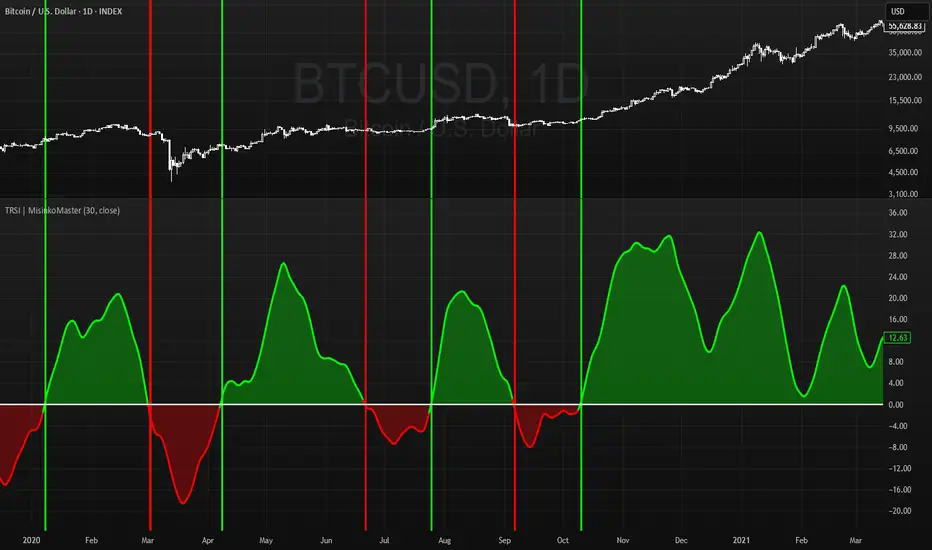
Triple RSI | MisinkoMasterThe Triple RSI (TRSI) is an advanced trend-following oscillator designed to capture trend reversals with speed and smoothness, combining concepts from traditional RSI, multi-timeframe momentum analysis, and layered moving average smoothing. By blending multiple RSI lengths and applying a unique smoothing sequence, the TRSI creates a fast, momentum-driven RSI oscillator that reduces noise without sacrificing responsiveness. 🔎 Methodology The indicator is built in three main steps: Multi-Length RSI Calculation Three RSIs are calculated using different lengths derived from the user’s input n: RSI(√n) → very fast, highly responsive. RSI(n/2) → moderately fast. RSI(n) → slower, more stable baseline. Each RSI is normalized by subtracting 50, centering values around zero. Triple RSI Formula The three RSIs are combined into the base formula: TRSI=RSI(√n)+RSI(n/2)−RSI(n) TRSI=RSI(√n)+RSI(n/2)−RSI(n) This subtracts the slower RSI from the faster ones, boosting responsiveness and making the TRSI more momentum-oriented than a standard RSI. Layered Smoothing The raw TRSI is smoothed in three steps: RMA(n/2) RMA(√n) HMA(√n) This sequence balances stability and speed: RMA provides consistency and reduces false noise. HMA adds responsiveness and precision. The result is a smooth yet reactive oscillator, optimized for reversal detection. 📈 Trend Classification The TRSI offers three ways to interpret trend direction: Oscillator Values Above 0 → Bullish (uptrend). Below 0 → Bearish (downtrend). Oscillator Colors Green TRSI line → Positive momentum. Red TRSI line → Negative momentum. Background Colors Green background flash → Reversal into bullish trend. Red background flash → Reversal into bearish trend. This makes it easy to scan past price history and quickly identify turning points. 🎨 Visualization TRSI line plotted with dynamic coloring (green/red). Filled area between TRSI and zero-line reflects momentum bias. Background flashes highlight trend reversal points, adding context and clarity for visual traders. ⚡ Features Adjustable length parameter (n). Dynamic use of √n and n/2 for multi-speed RSI blending. Built-in smoothing with 2× RMA + 1× HMA. Multiple trend detection methods (value, color, background). Works across all assets and timeframes (crypto, forex, stocks, indices). ✅ Use Cases Reversal Detection → Catch early shifts in trend direction. Trend Confirmation → Stay aligned with momentum. Momentum Filter → Avoid counter-trend trades in trending markets. Historical Analysis → Quickly scan past reversals via background coloring. ⚠️ Limitations As with all oscillators, TRSI may give false signals in sideways/choppy markets. Optimal sensitivity depends on asset volatility → adjust n for best results. It is not a standalone system and should be combined with other tools (trend filters, volume, higher timeframe confluence).อินดิเคเตอร์ Pine Script®โดย MisinkoMaster22140
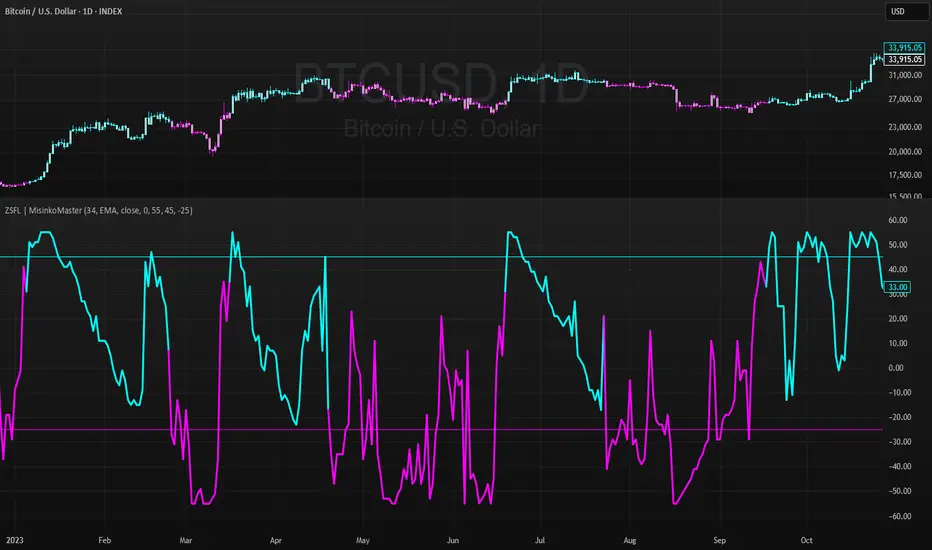
Z-Score For Loop | MisinkoMasterThe Z-Score For Loop (ZSFL) is a unique trend-following oscillator designed to detect potential reversals and momentum shifts earlier than traditional tools, providing traders with fast, adaptive, and reliable signals. Unlike common smoothing techniques (moving averages, medians, or modes), the ZSFL introduces a for-loop comparison method that balances speed and noise reduction, resulting in a powerful reversal-detection system. 🔎 Methodology The indicator is built in two main stages: Z-Score Calculation Formula: Z=(Source−Mean)/Standard Deviation Z= Standard Deviation (Source−Mean) The user can select the averaging method for the mean: SMA, EMA, WMA, HMA, DEMA, or TEMA. Recommended: EMA, SMA, or WMA for balanced accuracy. The choice of biased (sample) or unbiased (population) standard deviation is also available. ➝ On its own, the raw Z-score is fast but noisy, requiring additional filtering. For Loop Logic (Noise Reduction) Instead of using traditional smoothing (which adds lag), the indicator applies a for loop comparison. The current Z-score is compared against previous values over a user-defined range (start → end). Each comparison adds or subtracts “points”: +1 point if the current Z-score is higher than a past Z-score. -1 point if it is lower. The final value is the cumulative score, reflecting whether the Z-score is generally stronger or weaker than its historical context. ➝ This approach keeps speed intact while removing much of the false noise that raw Z-scores generate. 📈 Trend Logic Bullish Signal (Cyan) → Triggered when the score crosses above the upper threshold (default +45). Bearish Signal (Magenta) → Triggered when the score crosses below the lower threshold (default -25). Neutral → When the score remains between the thresholds. Thresholds are adjustable, making the tool flexible for different assets and timeframes. 🎨 Visualization The ZSFL score is plotted as a main oscillator line. Upper and lower thresholds are plotted as static reference levels. The price chart can also be color-coded with trend signals (cyan for bullish, magenta for bearish) to provide immediate visual confirmation. ⚡ Features Adjustable Z-score length (len). Multiple average types for the mean (SMA, EMA, WMA, HMA, DEMA, TEMA). Toggle between biased vs. unbiased SD calculations. Adjustable For Loop range (start, end). Adjustable upper and lower thresholds for signal generation. Works as both an oscillator and a price overlay tool. ✅ Use Cases Reversal Detection → Spot early shifts before price confirms them. Trend Confirmation → Use thresholds to filter false reversals. System Filter → Combine with trend indicators to refine entries. Multi-Timeframe Setup → Works well across different timeframes for swing, day, or intraday trading. ⚠️ Limitations As with all oscillators, the ZSFL will generate false signals in sideways/choppy markets. Optimal parameters (length, loop size, thresholds) may differ across assets. It is not a standalone trading system — use alongside other forms of analysis (trend filters, volume, higher timeframe confluence).อินดิเคเตอร์ Pine Script®โดย MisinkoMaster29
BTC Spread: Coinbase Spot vs CME Futures (skullcap)BTC Spread: Coinbase Spot vs CME Futures This indicator plots the real-time spread between Coinbase Spot BTC (COINBASE:BTCUSD) and CME Bitcoin Futures (CME:BTC1!). It allows traders to monitor the premium or discount between spot and futures markets directly in one chart. ⸻ 📊 How it Works • The script pulls Coinbase spot BTC closing prices and CME front-month BTC futures prices on your selected timeframe. • The spread is calculated as: Spread = CME Price – Coinbase Spot Price 🔧 How to Use 1. Add the indicator to your chart (set to any timeframe you prefer). 2. The orange line represents the spread (USD difference). 3. The grey dashed line marks the zero level (parity between CME and Coinbase). 4. Use it to: • Compare futures vs. spot market structure • Track premium/discount cycles around funding or expiry • Identify arbitrage opportunities or market dislocations ⸻ ⚠️ Notes • This indicator is informational only and does not provide trading signals. • Useful for traders analysing derivatives vs spot price action. • Works best when paired with order flow, funding rate, and open interest data.อินดิเคเตอร์ Pine Script®โดย skullcap_ftm14
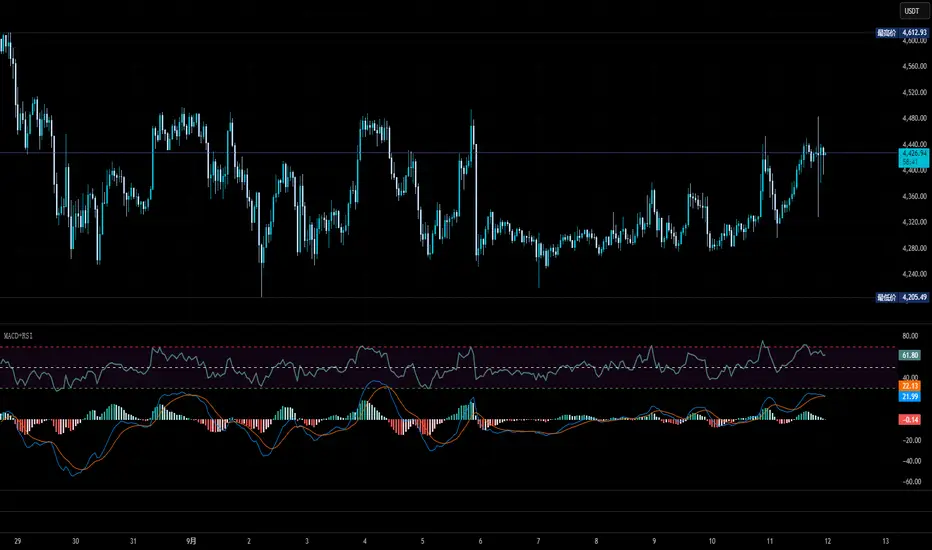
MACD ProThe MACD Pro is a modern take on the classic MACD, designed to give traders deeper insights into market momentum, trend conditions, and potential turning points. While it keeps the standard MACD foundation, it introduces a few enhancements to make it more adaptive and visually intuitive. At its core, the indicator calculates the traditional MACD line, Signal line and Histogram. The histogram can be optionally displayed. One of the things that set this version apart is the addition of the MACD Leader, an optional feature that makes the MACD more responsive to price action. By applying an adaptive smoothing factor (Leader Sensitivity), the Leader line can provide earlier momentum cues compared to the standard MACD and help anticipate shifts before they become obvious on a standard MACD indicator. Another enhancement is the regime-based color system for the MACD line. Instead of simply coloring based on the MACD or histogram itself, this indicator identifies the overall market regime using momentum and trend strength conditions. Bullish Regime: Momentum is positive and trend strength is above average. Bearish Regime: Momentum is negative and trend strength is above average. Sideways Regime: Momentum remains weak and within noise levels. This regime detection allows the MACD line to visually adapt, giving traders an extra layer of context beyond standard MACD signals to blend momentum analysis with market conditions, helping distinguish between trending and ranging environments.อินดิเคเตอร์ Pine Script®โดย VEGAlgo94
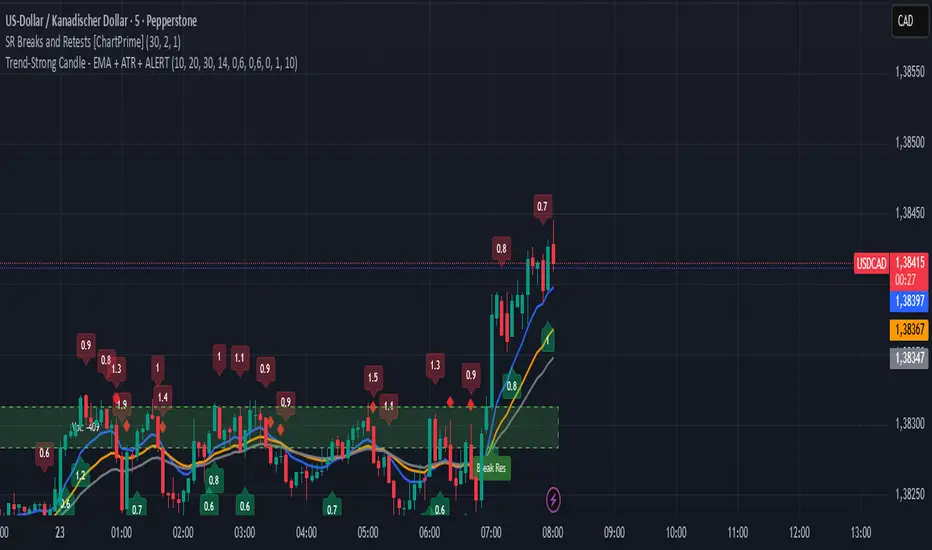
Trend-Strong Candle - Pro Multi Assetighlights: Major Assets Mode (optional): EURUSD, GBPUSD, USDJPY, AUDUSD, USDCAD, NZDUSD, EURGBP, EURJPY One‑per‑bar alerts, 24/7 toggle, no session limits Default EMAs 20/40/60, improved stability and EMA-close filters Lightweight performance, warning-free calculations, and clearer arrows/plotsอินดิเคเตอร์ Pine Script®โดย depauleที่อัปเดต: 72
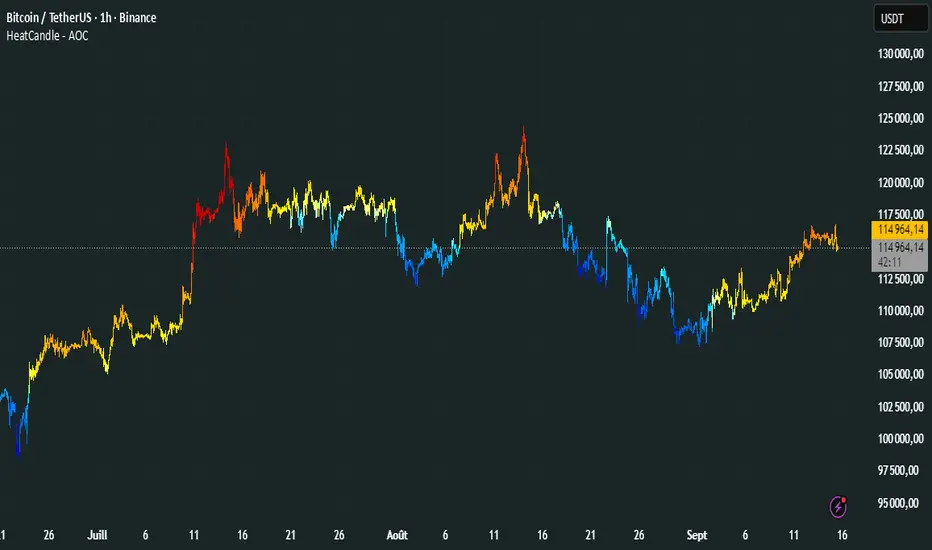
HeatCandleHeatCandle - AOC Indicator ✨ Features 📊 Heat-Map Candles: Colors candles based on the price’s deviation from a Triangular Moving Average (TMA), creating a heat-map effect to visualize price zones. 📏 Zone-Based Coloring: Assigns colors to 20 distinct zones (Z0 to Z19) based on the percentage distance from the TMA, with customizable thresholds. ⚙️ Timeframe-Specific Zones: Tailored zone thresholds for 1-minute, 5-minute, 15-minute, 30-minute, 1-hour, and 4-hour timeframes for precise analysis. 🎨 Customizable Visuals: Gradient color scheme from deep blue (oversold) to red (overbought) for intuitive price movement interpretation. 🛠️ Adjustable Parameters: Configure TMA length and threshold multiplier to fine-tune sensitivity. 🛠️ How to Use Add to Chart: Apply the "HeatCandle - AOC" indicator on TradingView. Configure Inputs: TMA Length: Set the period for the Triangular Moving Average (default: 150). Threshold Multiplier: Adjust the multiplier to scale zone sensitivity (default: 1.0). Analyze: Observe colored candles on the chart, where colors indicate the price’s deviation from the TMA: Dark blue (Z0) indicates strong oversold conditions. Red (Z19) signals strong overbought conditions. Track Trends: Use the color zones to identify potential reversals, breakouts, or trend strength based on price distance from the TMA. 🎯 Why Use It? Visual Clarity: The heat-map candle coloring simplifies identifying overbought/oversold conditions at a glance. Timeframe Flexibility: Zone thresholds adapt to the selected timeframe, ensuring relevance across short and long-term trading. Customizable Sensitivity: Adjust TMA length and multiplier to match your trading style or market conditions. Versatile Analysis: Ideal for scalping, swing trading, or trend analysis when combined with other indicators. 📝 Notes Ensure sufficient historical data for accurate TMA calculations, especially with longer lengths. The indicator is most effective on volatile markets where price deviations are significant. Pair with momentum indicators (e.g., RSI, MACD) or support/resistance levels for enhanced trading strategies. Happy trading! 🚀📈อินดิเคเตอร์ Pine Script®โดย AlchimistOfCryptoที่อัปเดต: 2258
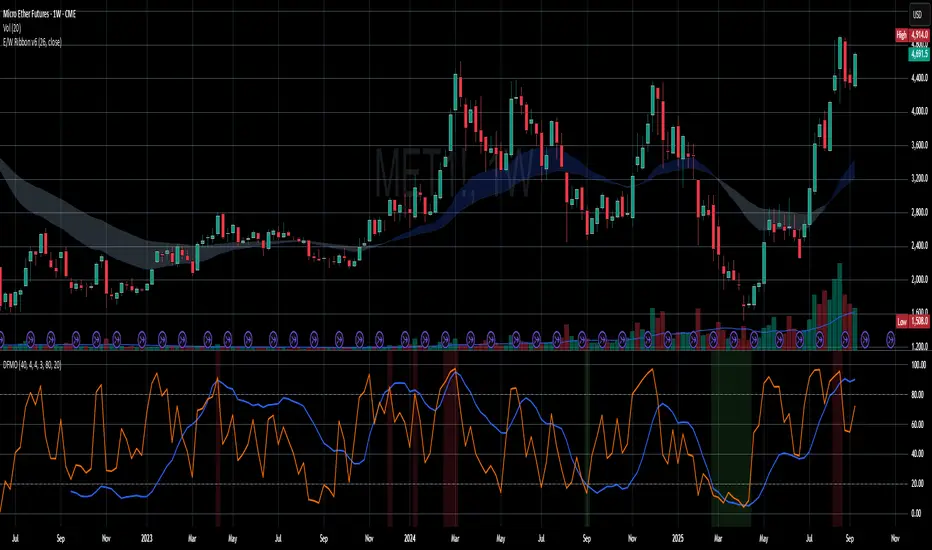
Dual-Frame Momentum OscillatorDual-Frame Momentum Oscillator (DFMO) This is not just another oscillator. This is a confluence engine, built for the discerning trader who reads the story of price action and needs an objective tool to confirm the climax. The Dual-Frame Momentum Oscillator was designed to solve a specific problem: how to differentiate a genuine, sustainable breakout from an exhaustive liquidity grab. It provides a visual confirmation for high-probability reversal and scalp setups by measuring momentum across two distinct time frames simultaneously. This tool is for the trader who understands that indicators should not dictate trades, but rather confirm a well-defined thesis based on market structure, volume, and liquidity. The Core Concept: Context Meets Trigger The DFMO fuses a slow, methodical Stochastic with a hyper-sensitive RSI to give you a complete picture of momentum. The Context (Slow Stochastic %K - default 40,4,4): This acts as your long-term momentum gauge. It tells you if the underlying trend is healthy or nearing exhaustion. A high reading suggests the market is overextended and vulnerable, while a low reading suggests the opposite. The Trigger (Fast RSI - default 3): This is your immediate impulse reader. It measures the velocity and intensity of the current price thrust, making it incredibly sensitive to exhaustive moves, spikes, and bounces. By themselves, they are useful. Together, they are formidable. The Confluence Engine: Your Visual Edge The true power of the DFMO lies in its "Confluence Engine." The indicator's background highlights in real-time when both oscillators are in agreement, visually flagging moments of maximum opportunity. Bearish Confluence Zone (Red): The background turns red only when the Stochastic is overbought AND the RSI is overbought. This is your signal that the broader trend is exhausted and the current buying impulse has reached a climax. It is the ideal confirmation for a short entry following a liquidity sweep above a key high. Bullish Confluence Zone (Green): The background turns green only when the Stochastic is oversold AND the RSI is oversold. This signals that the downtrend is tired and the immediate selling pressure is exhaustive, providing high-probability confirmation for a long entry at a key support level. When these zones appear, the indicator is telling you that both the context and the trigger are aligned. This removes ambiguity and allows for decisive, confident execution. Practical Application: The Liquidity Sweep Imagine you're stalking a short on a futures contract like MCL or MES. You've marked the high of the day (HOD) as a key resistance level where liquidity is resting. You see a sharp, vertical impulse move that breaks the HOD, clearing out the stops. Is this a real breakout, or is it a manipulation move—a classic liquidity grab? You glance down at the DFMO. The moment price swept the high, the background flashed red. That's your objective confirmation. The slow Stoch was already overbought, and the fast RSI spiking confirmed the exhaustive, terminal nature of that price thrust. You now have the confidence to enter your short scalp, knowing you are aligned with the probable direction of the market's next move. This is how you move from "feeling" the market to systematically executing a high-probability edge. This is how you aspire for greatness. Add the Dual-Frame Momentum Oscillator to your toolkit and transform your ability to time entries with surgical precision.อินดิเคเตอร์ Pine Script®โดย rick84etter36
Fibo RSIThis is a customized Relative Strength Index (RSI) indicator designed to replicate TradingView’s default RSI while adding additional reference levels for deeper market analysis. 🔹 Features: RSI length set to 8 by default (user adjustable). Calculates RSI using the standard ta.rsi() function. Plots the RSI line in a clean, separate panel. Adds 7 key levels for analysis: 0, 20, 30, 50, 70, 80, 100. Levels are drawn as thin, solid straight lines for a cleaner look (instead of default dashed). 🔹 Use cases: Identify momentum shifts with enhanced precision. Use intermediate levels (20, 30, 50, 70, 80) as potential support/resistance zones. Ideal for traders who want a Fibonacci-like structure in RSI analysis.อินดิเคเตอร์ Pine Script®โดย MALIK89733
Swing Oracle Stock 2.0- Gradient Enhanced# 🌈 Swing Oracle Pro - Advanced Gradient Trading Indicator **Transform your technical analysis with stunning gradient visualizations that make market trends instantly recognizable.** ## 🚀 **What Makes This Indicator Special?** The **Swing Oracle Pro** revolutionizes traditional technical analysis by combining advanced NDOS (Normalized Distance from Origin of Source) calculations with a sophisticated gradient color system. This isn't just another indicator—it's a complete visual trading experience that adapts colors based on market strength, making trend identification effortless and intuitive. ## 🎨 **10 Professional Gradient Themes** Choose from carefully crafted color schemes designed for optimal visual clarity: - **🌅 Sunset** - Warm oranges and purples for classic elegance - **🌊 Ocean** - Cool blues and teals for calm analysis - **🌲 Forest** - Natural greens and browns for organic feel - **✨ Aurora** - Ethereal greens and magentas for mystique - **⚡ Neon** - Vibrant electric colors for high-energy trading - **🌌 Galaxy** - Deep purples and cosmic hues for night sessions - **🔥 Fire** - Intense reds and golds for volatile markets - **❄️ Ice** - Cool whites and blues for clear-headed decisions - **🌈 Rainbow** - Full spectrum for comprehensive analysis - **⚫ Monochrome** - Professional grays for focused trading ## 📊 **Core Features** ### **Advanced NDOS System** - Normalized Distance from Origin of Source calculation with 231-period length - Smoothed with customizable EMA for reduced noise - Multi-timeframe confirmation with H1 filter option - Dynamic gradient coloring based on oscillator position ### **Intelligent Visual Feedback** - **Primary Gradient Line** - Main NDOS plot with dynamic color transitions - **Gradient Fill Zones** - Beautiful color-coded areas for bullish, neutral, and bearish regions - **Smart Transparency** - Colors adjust intensity based on market volatility - **Dynamic Backgrounds** - Subtle gradient backgrounds that respond to market conditions ### **Enhanced EMA Projection System** - 75/760 period EMA normalization with 50-period lookback - Gradient-colored projection line for trend forecasting - Toggleable display with advanced gradient controls - Price tracking for precise level identification ### **Multi-Timeframe Analysis Table** - Real-time trend analysis across 6 timeframes (1m, 3m, 5m, 15m, 1H, 4H) - Gradient-colored cells showing trend strength - Customizable table size and position - Professional emoji indicators (🚀 UP, 📉 DOWN, ➡️ FLAT) ### **Signal System** - **Gradient Buy Signals** - Triangle up arrows with intensity-based coloring - **Gradient Sell Signals** - Triangle down arrows with strength indicators - **Alert Conditions** - Built-in alerts for all signal types - **7-Day Cycle Tracking** - Tuesday-to-Tuesday weekly cycle visualization ## ⚙️ **Customization Controls** ### **🎨 Gradient Controls** - **Gradient Intensity** - Adjust color vibrancy (0.1-1.0) - **Gradient Smoothing** - Control color transition smoothness (1-10 periods) - **Dynamic Background** - Toggle animated background gradients - **Advanced Gradients** - Enable/disable EMA projection and enhanced features ### **🛠️ Custom Color System** - **Bullish Colors** - Define custom start/end colors for bull markets - **Bearish Colors** - Set personalized bear market gradients - **Full Theme Override** - Create completely custom color schemes - **Real-time Preview** - See changes instantly on your chart ## 📈 **How to Use** 1. **Choose Your Theme** - Select from 10 professional gradient themes 2. **Configure Levels** - Adjust high/low levels (default 60/40) for your timeframe 3. **Set Smoothing** - Fine-tune gradient smoothing for your trading style 4. **Enable Features** - Toggle background gradients, candlestick coloring, and advanced EMA projection 5. **Monitor Signals** - Watch for gradient buy/sell arrows and multi-timeframe confirmations ## 🎯 **Trading Applications** - **Swing Trading** - Perfect for identifying medium-term trend changes - **Scalping** - Multi-timeframe table provides quick trend confirmation - **Position Sizing** - Gradient intensity shows signal strength for risk management - **Market Analysis** - Beautiful visualizations make complex data instantly understandable - **Education** - Ideal for learning market dynamics through visual feedback ## ⚡ **Performance Optimized** - **Smart Rendering** - Colors update only on significant changes - **Efficient Calculations** - Optimized algorithms for smooth performance - **Memory Management** - Minimal resource usage even with complex gradients - **Real-time Updates** - Responsive to market changes without lag ## 🚨 **Alert System** Built-in alert conditions notify you when: - NDOS crosses above high level (Buy Signal) - NDOS crosses below low level (Sell Signal) - Multi-timeframe confirmations align - Customizable alert messages with emoji indicators ## 🔧 **Technical Specifications** - **PineScript Version**: v6 (Latest) - **Overlay**: True (plots on main chart) - **Calculations**: NDOS, EMA normalization, volatility-based transparency - **Timeframes**: Compatible with all timeframes - **Markets**: Stocks, Forex, Crypto, Commodities, Indices ## 💡 **Why Choose Swing Oracle Pro?** This isn't just another technical indicator—it's a complete visual transformation of your trading experience. The gradient system provides instant visual feedback that traditional indicators simply can't match. Whether you're a beginner learning to read market trends or an experienced trader seeking clearer signals, the Swing Oracle Pro delivers professional-grade analysis with unprecedented visual clarity. **Experience the future of technical analysis. Your charts will never look the same.** --- *⚠️ Disclaimer: This indicator is for educational and informational purposes only. Past performance does not guarantee future results. Always conduct your own research and consider risk management before making trading decisions.* **🔔 Like this indicator? Please leave a comment and boost! Your feedback helps improve future updates.** --- **📝 Tags:** #GradientTrading #SwingTrading #NDOS #MultiTimeframe #TechnicalAnalysis #VisualTrading #TrendAnalysis #ColorCoded #ProfessionalCharts #TradingTooอินดิเคเตอร์ Pine Script®โดย FollowtheWhiteRabbitz1116
High-and-Tight Impulse + Micro ConsolidationThis indicator detects a specific bullish continuation setup on daily charts: - An impulse move (X% rise within N bars, mostly green candles) - Immediately followed by a tight consolidation (small ranges, small bodies) - Closes holding in the top zone of the impulse On the chart, signals are plotted as orange dots above bars. Labels show the last detected setup date, and a counter displays total matches in history. Useful for backtesting "high-and-tight flag" type momentum patterns or any symbol. Adjust inputs (impulse % threshold, bars, ATR ratios, top zone %) to make it stricter or looser. Alerts are included when a new setup is detected. This tool is not financial advice. For educational and research purposes only. by fiyatherseydirอินดิเคเตอร์ Pine Script®โดย fiyatherseydir12
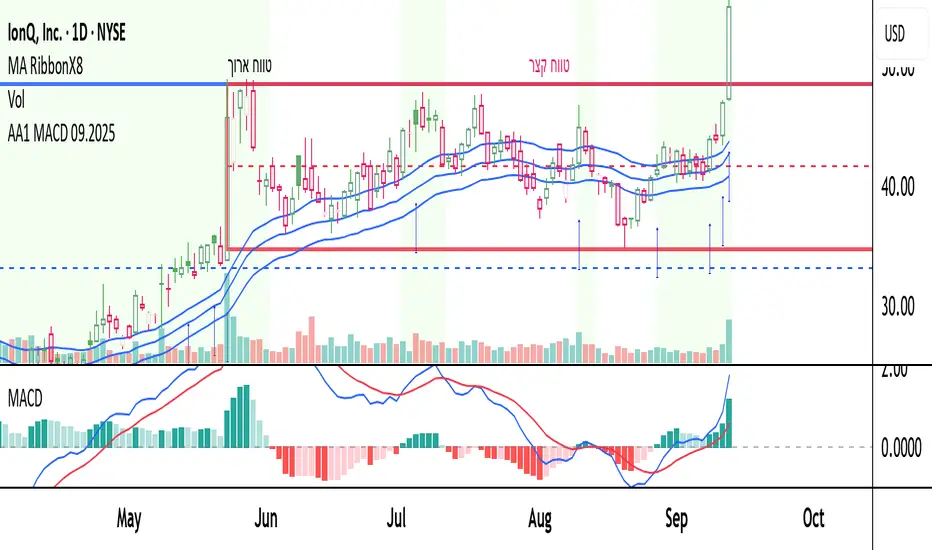
AA1 MACD 09.2025this is a learing project i want to share the script is open for anyone I combain some ema's mcad and more indicators to help find stocks in momentumอินดิเคเตอร์ Pine Script®โดย avi16
Trend-Strong Candle - 3 EMAs with Filters# Trend-Strong Candle - Professional Trading Indicator ## 📊 What It Does Identifies high-probability entries by combining triple EMA trend analysis with strong candle detection. Only signals when all conditions align for maximum accuracy. ## 🎯 Core Features - Triple EMA System: Fast (20) / Medium (50) / Slow (200) for trend confirmation - Strong Candle Filter: ATR-based sizing ensures genuine momentum - Advanced Filters: EMA close validation + trend stability checks - Live Alerts: Instant notifications for real-time signals - Session Filter: Trade only during active EU/US market hours ## ⚡ Quick Setup Scalping (1-5min): Default settings + enable session filter Day Trading (15-60min): Default settings work perfectly Swing Trading (4H+): Increase ATR multiplier to 0.8-1.0 ## 📈 Trading Rules Long Signals: Green triangle below candle - Strong bullish candle during confirmed uptrend - All EMAs properly aligned (Fast > Medium > Slow) Short Signals: Red triangle above candle - Strong bearish candle during confirmed downtrend - All EMAs properly aligned (Fast < Medium < Slow) ## ⚠️ Critical Success Factors 1. Always Verify the Trend Yourself The indicator helps identify signals, but YOU must confirm the larger trend context. Check higher timeframes and overall market structure before entering. 2. Understand the "Big Players" Strong candles in trend direction usually come from institutional money (banks, funds, algorithms). These create the momentum that retail traders can follow. The indicator catches these institutional moves. 3. Distance to Next Value Level NEVER enter if price is too close to major resistance/support levels: - Check distance to round numbers (1.1000, 1.1050, etc.) - Ensure at least 20-30 pips room to next key level - You need space for profit - tight levels = limited upside 4. Risk Management - Stop Loss: 1-2 ATR from entry - Take Profit: 2-3 ATR target (minimum 1:2 R/R) - Position Size: Risk max 1-2% per trade ## 💡 Pro Tips - Best Sessions: London open (8-12 UTC) and NY open (13-17 UTC) - Avoid: Major news, low liquidity periods, choppy markets - Multiple Timeframes: Confirm signals on higher timeframe - Value Levels: Always check daily/weekly support/resistance before entering ## 🎯 Success Formula Trend Confirmation + Strong Institutional Candle + Distance to Value Levels = High Probability Trade * Remember: The indicator finds the signals, but successful trading requires your analysis of trend context and value level positioning. Trade smart, not just frequent. อินดิเคเตอร์ Pine Script®โดย depauleที่อัปเดต: 65
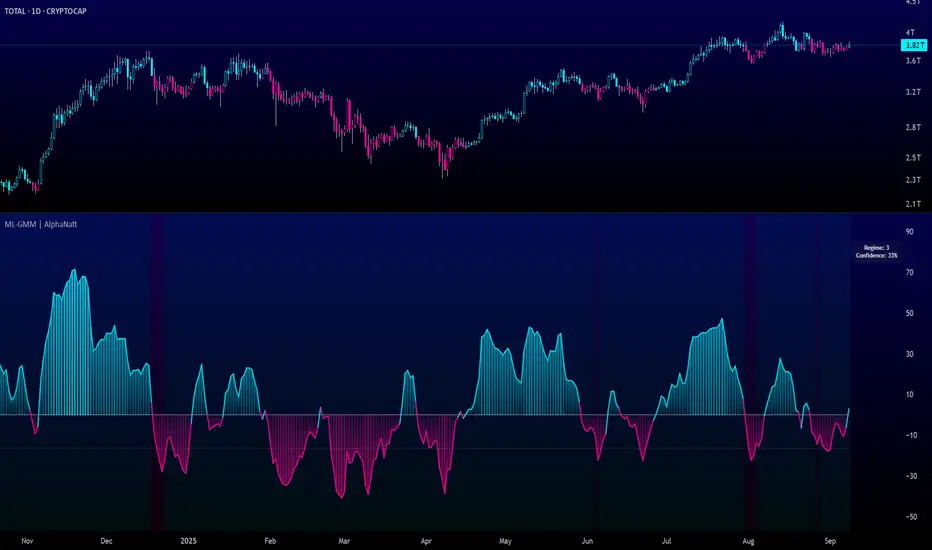
Machine Learning Gaussian Mixture Model | AlphaNattMachine Learning Gaussian Mixture Model | AlphaNatt A revolutionary oscillator that uses Gaussian Mixture Models (GMM) with unsupervised machine learning to identify market regimes and automatically adapt momentum calculations - bringing statistical pattern recognition techniques to trading. "Markets don't follow a single distribution - they're a mixture of different regimes. This oscillator identifies which regime we're in and adapts accordingly." ━━━━━━━━━━━━━━━━━━━━━━━━━━━━━━━━━━━━━━━━ 🤖 THE MACHINE LEARNING Gaussian Mixture Models (GMM): Unlike K-means clustering which assigns hard boundaries, GMM uses probabilistic clustering : Models data as coming from multiple Gaussian distributions Each market regime is a different Gaussian component Provides probability of belonging to each regime More sophisticated than simple clustering Expectation-Maximization Algorithm: The indicator continuously learns and adapts using the E-M algorithm: E-step: Calculate probability of current market belonging to each regime M-step: Update regime parameters based on new data Continuous learning without repainting Adapts to changing market conditions ━━━━━━━━━━━━━━━━━━━━━━━━━━━━━━━━━━━━━━━━ 🎯 THREE MARKET REGIMES The GMM identifies three distinct market states: Regime 1 - Low Volatility: Quiet, ranging markets Uses RSI-based momentum calculation Reduces false signals in choppy conditions Background: Pink tint Regime 2 - Normal Market: Standard trending conditions Uses Rate of Change momentum Balanced sensitivity Background: Gray tint Regime 3 - High Volatility: Strong trends or volatility events Uses Z-score based momentum Captures extreme moves Background: Cyan tint ━━━━━━━━━━━━━━━━━━━━━━━━━━━━━━━━━━━━━━━━ 💡 KEY INNOVATIONS 1. Probabilistic Regime Detection: Instead of binary regime assignment, provides probabilities: 30% Regime 1, 60% Regime 2, 10% Regime 3 Smooth transitions between regimes No sudden indicator jumps 2. Weighted Momentum Calculation: Combines three different momentum formulas Weights based on regime probabilities Automatically adapts to market conditions 3. Confidence Indicator: Shows how certain the model is (white line) High confidence = strong regime identification Low confidence = transitional market state Line transparency changes with confidence ━━━━━━━━━━━━━━━━━━━━━━━━━━━━━━━━━━━━━━━━ ⚙️ PARAMETER OPTIMIZATION Training Period (50-500): 50-100: Quick adaptation to recent conditions 100: Balanced (default) 200-500: Stable regime identification Number of Components (2-5): 2: Simple bull/bear regimes 3: Low/Normal/High volatility (default) 4-5: More granular regime detection Learning Rate (0.1-1.0): 0.1-0.3: Slow, stable learning 0.3: Balanced (default) 0.5-1.0: Fast adaptation ━━━━━━━━━━━━━━━━━━━━━━━━━━━━━━━━━━━━━━━━ 📊 TRADING STRATEGIES Visual Signals: Cyan gradient: Bullish momentum Magenta gradient: Bearish momentum Background color: Current regime Confidence line: Model certainty 1. Regime-Based Trading: Regime 1 (pink): Expect mean reversion Regime 2 (gray): Standard trend following Regime 3 (cyan): Strong momentum trades 2. Confidence-Filtered Signals: Only trade when confidence > 70% High confidence = clearer market state Avoid transitions (low confidence) 3. Adaptive Position Sizing: Regime 1: Smaller positions (choppy) Regime 2: Normal positions Regime 3: Larger positions (trending) ━━━━━━━━━━━━━━━━━━━━━━━━━━━━━━━━━━━━━━━━ 🚀 ADVANTAGES OVER OTHER ML INDICATORS vs K-Means Clustering: Soft clustering (probabilities) vs hard boundaries Captures uncertainty and transitions More mathematically robust vs KNN (K-Nearest Neighbors): Unsupervised learning (no historical labels needed) Continuous adaptation Lower computational complexity vs Neural Networks: Interpretable (know what each regime means) No overfitting issues Works with limited data ━━━━━━━━━━━━━━━━━━━━━━━━━━━━━━━━━━━━━━━━ 📈 PERFORMANCE CHARACTERISTICS Best Market Conditions: Markets with clear regime shifts Volatile to trending transitions Multi-timeframe analysis Cryptocurrency markets (high regime variation) Key Strengths: Automatically adapts to market changes No manual parameter adjustment needed Smooth transitions between regimes Probabilistic confidence measure ━━━━━━━━━━━━━━━━━━━━━━━━━━━━━━━━━━━━━━━━ 🔬 TECHNICAL BACKGROUND Gaussian Mixture Models are used extensively in: Speech recognition (Google Assistant) Computer vision (facial recognition) Astronomy (galaxy classification) Genomics (gene expression analysis) Finance (risk modeling at investment banks) The E-M algorithm was developed at Stanford in 1977 and is one of the most important algorithms in unsupervised machine learning. ━━━━━━━━━━━━━━━━━━━━━━━━━━━━━━━━━━━━━━━━ 💡 PRO TIPS Watch regime transitions: Best opportunities often occur when regimes change Combine with volume: High volume + regime change = strong signal Use confidence filter: Avoid low confidence periods Multi-timeframe: Compare regimes across timeframes Adjust position size: Scale based on identified regime ━━━━━━━━━━━━━━━━━━━━━━━━━━━━━━━━━━━━━━━━ ⚠️ IMPORTANT NOTES Machine learning adapts but doesn't predict the future Best used with other confirmation indicators Allow time for model to learn (100+ bars) Not financial advice - educational purposes Backtest thoroughly on your instruments ━━━━━━━━━━━━━━━━━━━━━━━━━━━━━━━━━━━━━━━━ 🏆 CONCLUSION The GMM Momentum Oscillator brings institutional-grade machine learning to retail trading. By identifying market regimes probabilistically and adapting momentum calculations accordingly, it provides: Automatic adaptation to market conditions Clear regime identification with confidence levels Smooth, professional signal generation True unsupervised machine learning This isn't just another indicator with "ML" in the name - it's a genuine implementation of Gaussian Mixture Models with the Expectation-Maximization algorithm, the same technology used in: Google's speech recognition Tesla's computer vision NASA's data analysis Wall Street risk models "Let the machine learn the market regimes. Trade with statistical confidence." ━━━━━━━━━━━━━━━━━━━━━━━━━━━━━━━━━━━━━━━━ Developed by AlphaNatt | Machine Learning Trading Systems Version: 1.0 Algorithm: Gaussian Mixture Model with E-M Classification: Unsupervised Learning Oscillator Not financial advice. Always DYOR.อินดิเคเตอร์ Pine Script®โดย AlphaNatt33407
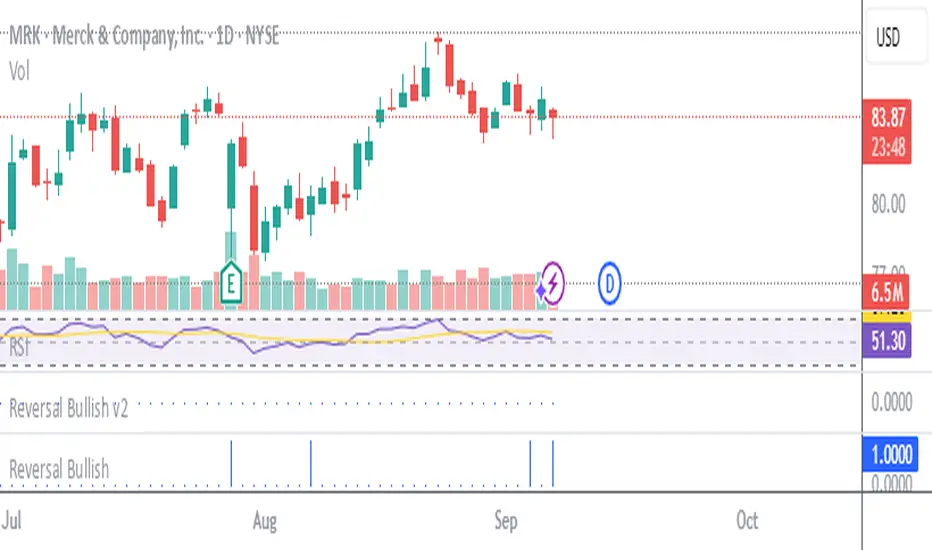
Stockbee Reversal BullishCustom indicator for identifying stocks that meet the Stockbee's Reversal Bullish criteria. This can be used as a standalone indicator or use it to screen for stocks in Pine Screener.อินดิเคเตอร์ Pine Script®โดย traderabhi8119
AI-Weighted RSI (Zeiierman)█ Overview AI-Weighted RSI (Zeiierman) is an adaptive oscillator that enhances classic RSI by applying a correlation-weighted prediction layer. Instead of looking only at RSI values directly, this indicator continuously evaluates how other price- and volume-based features (returns, volatility, volume shifts) correlate with RSI, and then weights them accordingly to project the next RSI state. The result is a smoother, forward-looking RSI framework that adapts to market conditions in real time. By leveraging feature correlation instead of static formulas, AI-Weighted RSI behaves like a lightweight learning model, adjusting its emphasis depending on which features are most aligned with RSI behavior during the current regime. █ How It Works ⚪ Feature Extraction Each bar, the script computes features: log returns, RSI itself, ATR% (volatility), volume, and volume log-change. ⚪ Correlation Screening Over a rolling learning window, it measures the correlation of each feature against RSI. The strongest relationships are ranked and selected. ⚪ Adaptive Weighting Features are standardized (z-scored), then combined using their signed correlations as weights, building a rolling, adaptive prediction of RSI. ⚪ Prediction to RSI Weight The predicted RSI is mapped back into a “weight” scale (±2 by default). Above 0 = bullish bias, below 0 = bearish bias, with color-graded fills to visualize overbought/oversold pressure. ⚪ Signal Line A smoothing option (signal length) overlays a moving average of the AI-Weighted RSI for clearer trend confirmation. █ Why AI-Weighted RSI ⚪ Adaptive to Market Regime Because the model re-evaluates correlations continuously, it naturally shifts which features dominate, sometimes volatility explains RSI best, sometimes volume, sometimes returns. ⚪ Forward-Looking Bias Instead of simply reflecting RSI, the model provides a projection, helping anticipate shifts in momentum before RSI itself flips. █ How to Use ⚪ Directional Bias Read the RSI relative to 0. Above = bullish momentum bias, below = bearish. ⚪ Overbought / Oversold Zones Shaded fills beyond +0.5 or -0.5 highlight extremes where RSI pressure often exhausts. ⚪ Divergences When price makes new highs/lows but AI-Weighted RSI fails to confirm, it often signals weakening momentum. █ Settings RSI Length: Lookback for the core RSI calculation. Signal Length: Smoothing applied to the AI-Weighted RSI output. Learning Window: Bars used for correlation learning and z-scoring. ----------------- Disclaimer The content provided in my scripts, indicators, ideas, algorithms, and systems is for educational and informational purposes only. It does not constitute financial advice, investment recommendations, or a solicitation to buy or sell any financial instruments. I will not accept liability for any loss or damage, including without limitation any loss of profit, which may arise directly or indirectly from the use of or reliance on such information. All investments involve risk, and the past performance of a security, industry, sector, market, financial product, trading strategy, backtest, or individual's trading does not guarantee future results or returns. Investors are fully responsible for any investment decisions they make. Such decisions should be based solely on an evaluation of their financial circumstances, investment objectives, risk tolerance, and liquidity needs. อินดิเคเตอร์ Pine Script®โดย Zeiierman33 1.1 K
عكفة الماكد المتقدمة - أبو فارس ©// 🔒 Advanced MACD Curve © 2025 // 💡 Idea & Creativity: Engineer Abu Elias // 🛠️ Development & Implementation: Abu Fares // 📜 All intellectual rights reserved - Copying, modifying, or redistributing is not permitted // 🚫 Any attempt to tamper with this code or violate intellectual property rights is legally prohibited // 📧 For inquiries and licensing: Please contact the developer, Abu Faresอินดิเคเตอร์ Pine Script®โดย ABU_FARIS12