

How to Use Candlesticks in a High-Probability Way | Tutorial #3
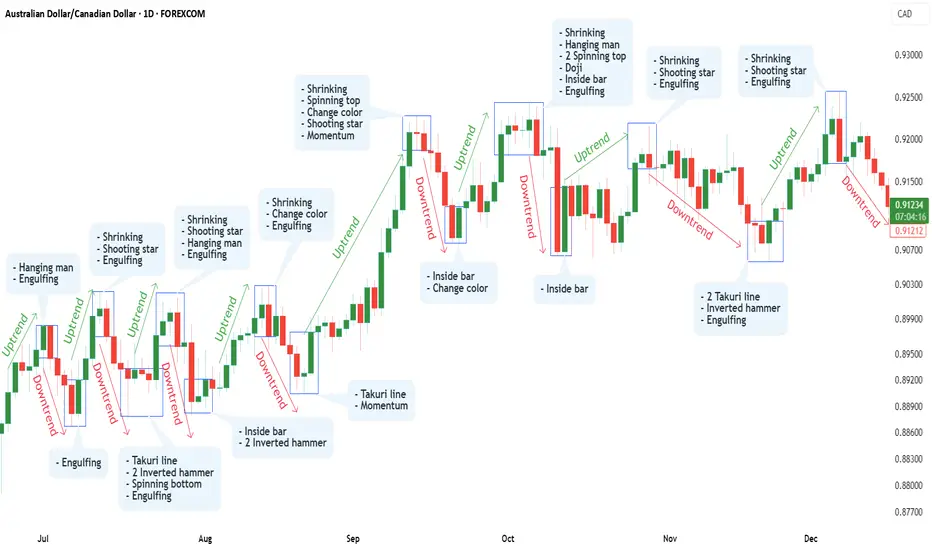
📊 Market Context: Ranging Market
This tutorial completes the trilogy of market conditions:
Trending (Uptrend & Downtrend) → Ranging Market.
From the next tutorials, we move into advanced concepts, where candlesticks are placed into proper context and combined with the most important element in trading — Support & Resistance.
🕯 Candlestick Types Covered in This Tutorial (Ranging Market)
🧠 Best Practice
Candlesticks should be read as clusters and sequences, not isolated signals.
This tutorial focuses on how candles stack together inside a ranging market to tell the full story.
⚠️ Important
Candlesticks alone are NOT enough.
High-probability setups come from combining them with:
This is how high-probability trading is built.
👉 Want Part 4?
From the next phase, we move into advanced trading:
combining candlesticks with Support & Resistance — this is where the real edge begins.
📈 Follow to catch the next tutorial.
⚠️ DISCLAIMER
This content is for educational purposes only and does not constitute financial advice.
Trading involves risk — always conduct your own analysis.
I am not responsible for any decisions or losses based on this material.
This tutorial completes the trilogy of market conditions:
Trending (Uptrend & Downtrend) → Ranging Market.
From the next tutorials, we move into advanced concepts, where candlesticks are placed into proper context and combined with the most important element in trading — Support & Resistance.
🕯 Candlestick Types Covered in This Tutorial (Ranging Market)
- Shrinking Candlesticks
➡️ Loss of momentum and reduced participation — balance, not an automatic reversal. - Inside Bar
➡️ Compression and consolidation inside the range, often before expansion. - Takuri Line
➡️ Strong rejection from range support — buyers stepping in. - Hanging Man
➡️ Context matters. In a range, it highlights supply — not a sell signal by itself. - Inverted Hammer
➡️ Buyer response after downside pressure within the range. - Spinning Top
➡️ Indecision between buyers and sellers. - Spinning Bottom
➡️ Temporary hesitation near range extremes. - Engulfing Candle
➡️ Strong participation when aligned with location and context. - Momentum Candlestick
➡️ Large-bodied candle showing aggressive participation. - Change Color Candle
➡️ After a sequence of same-colored candles, a color change may signal pause or shift.
🧠 Best Practice
Candlesticks should be read as clusters and sequences, not isolated signals.
This tutorial focuses on how candles stack together inside a ranging market to tell the full story.
⚠️ Important
Candlesticks alone are NOT enough.
High-probability setups come from combining them with:
- Support & Resistance
- Areas of Confluence
- Chart Patterns
- Trendlines
- Indicators
- Multi-timeframe context
This is how high-probability trading is built.
👉 Want Part 4?
From the next phase, we move into advanced trading:
combining candlesticks with Support & Resistance — this is where the real edge begins.
📈 Follow to catch the next tutorial.
⚠️ DISCLAIMER
This content is for educational purposes only and does not constitute financial advice.
Trading involves risk — always conduct your own analysis.
I am not responsible for any decisions or losses based on this material.

การนำเสนอที่เกี่ยวข้อง
คำจำกัดสิทธิ์ความรับผิดชอบ
ข้อมูลและบทความไม่ได้มีวัตถุประสงค์เพื่อก่อให้เกิดกิจกรรมทางการเงิน, การลงทุน, การซื้อขาย, ข้อเสนอแนะ หรือคำแนะนำประเภทอื่น ๆ ที่ให้หรือรับรองโดย TradingView อ่านเพิ่มเติมใน ข้อกำหนดการใช้งาน
การนำเสนอที่เกี่ยวข้อง
คำจำกัดสิทธิ์ความรับผิดชอบ
ข้อมูลและบทความไม่ได้มีวัตถุประสงค์เพื่อก่อให้เกิดกิจกรรมทางการเงิน, การลงทุน, การซื้อขาย, ข้อเสนอแนะ หรือคำแนะนำประเภทอื่น ๆ ที่ให้หรือรับรองโดย TradingView อ่านเพิ่มเติมใน ข้อกำหนดการใช้งาน