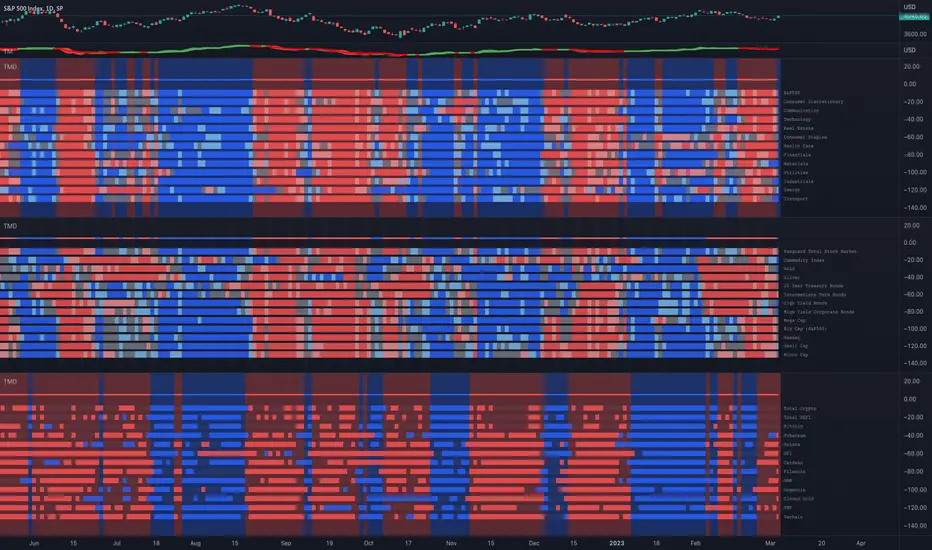
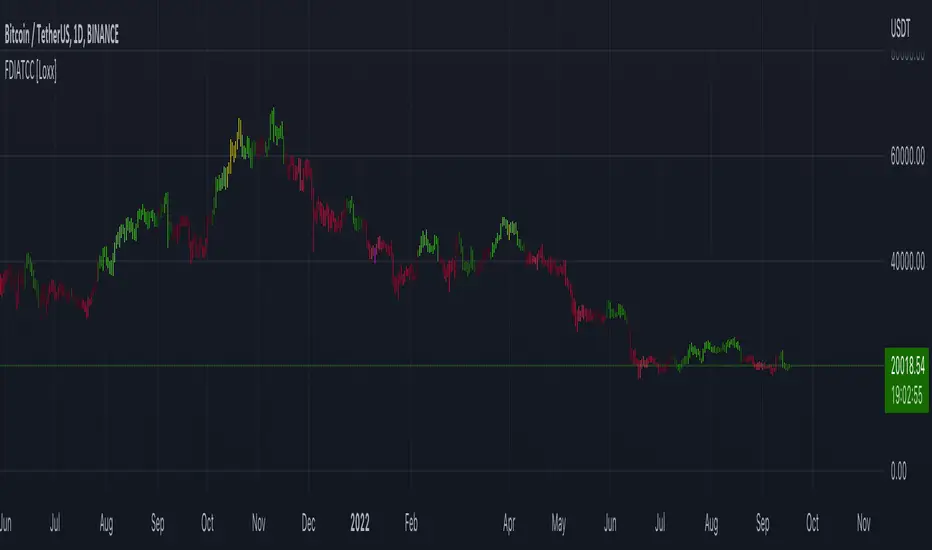
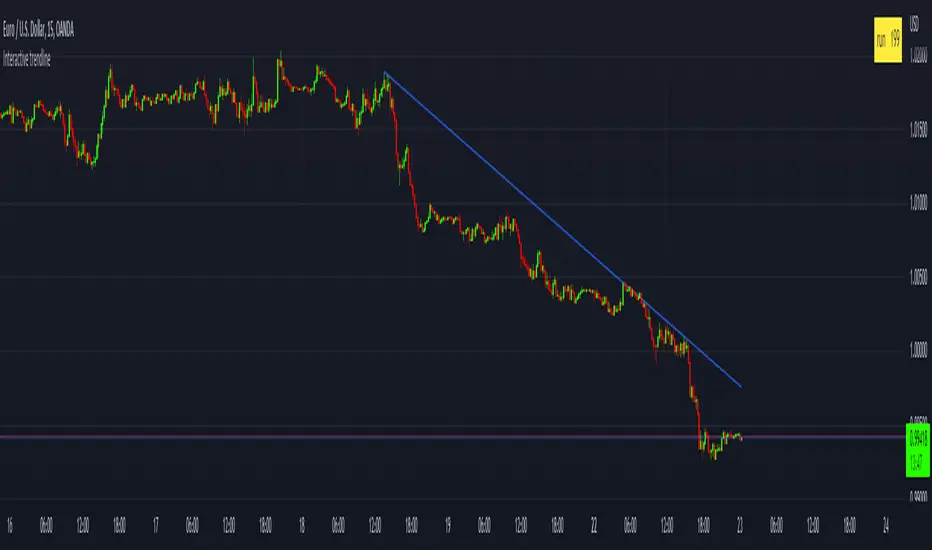
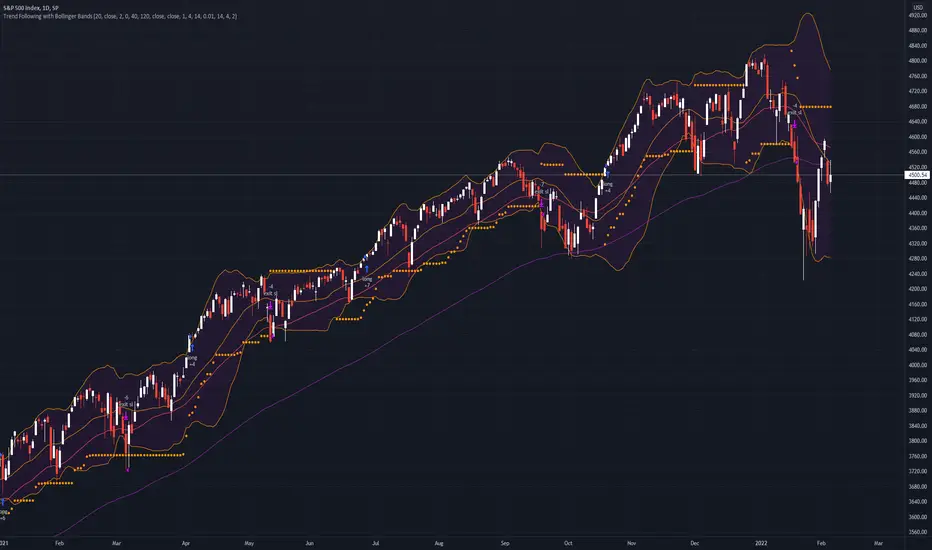
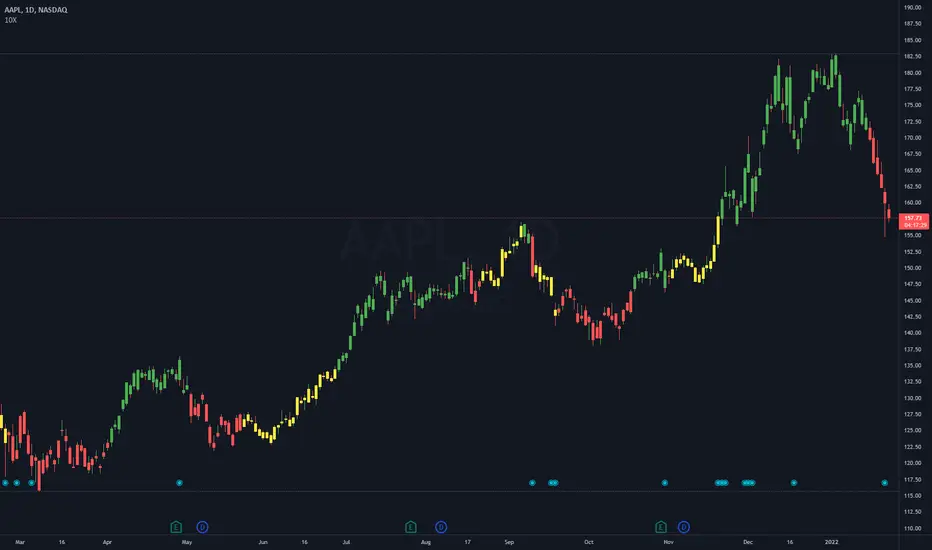
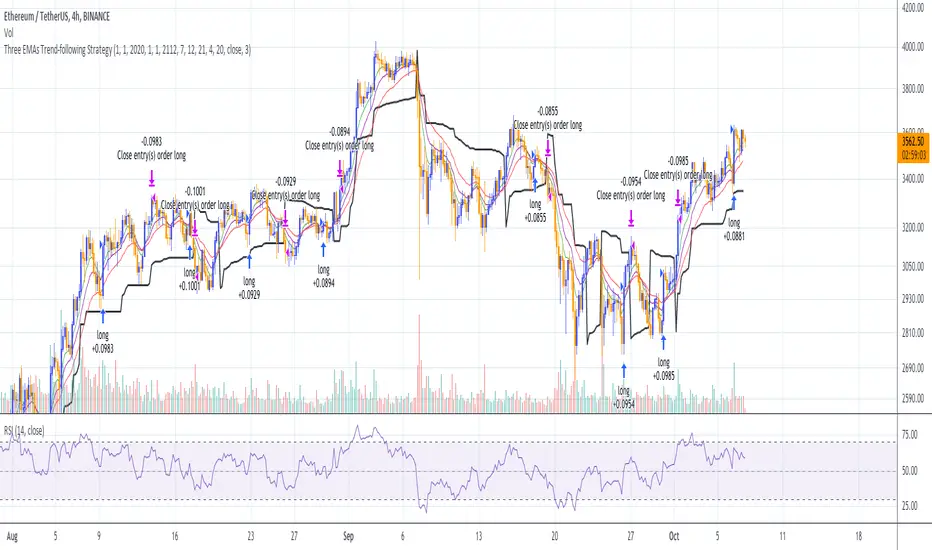
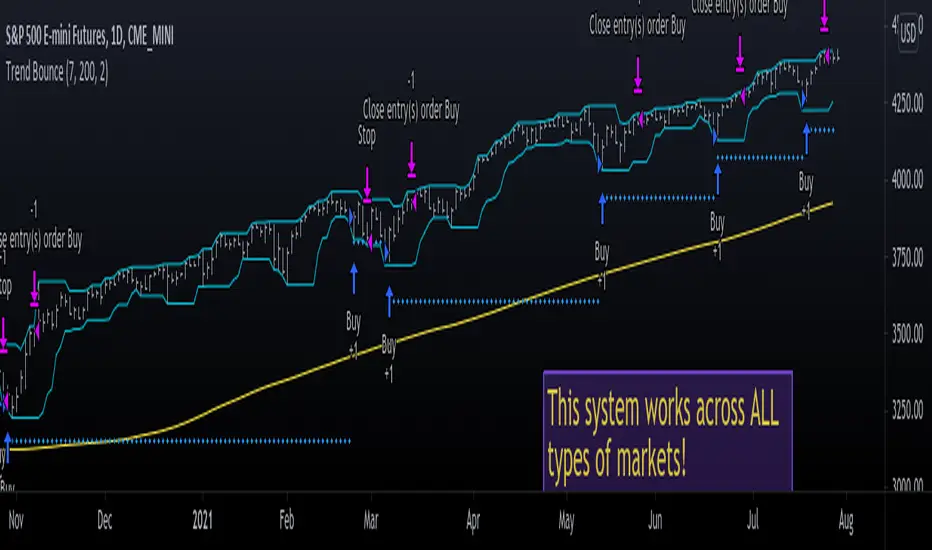
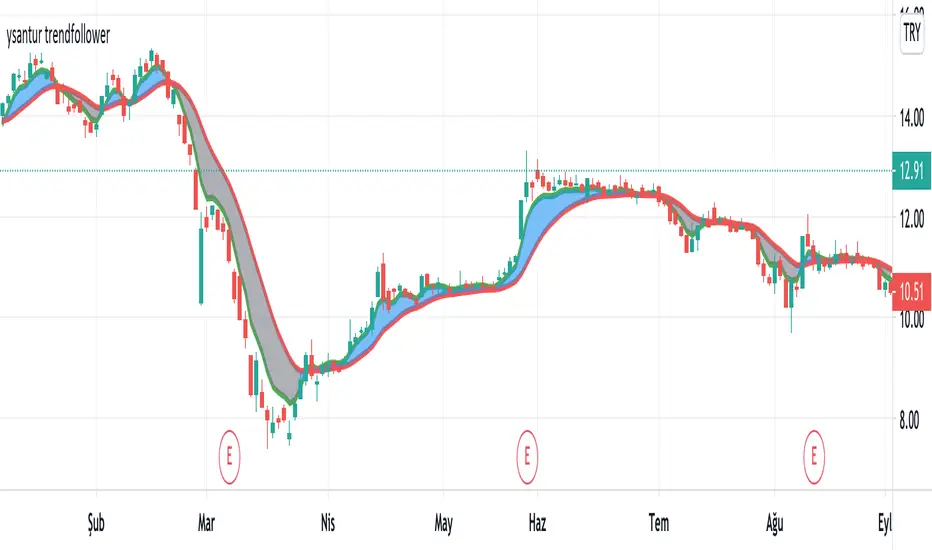
Trend ExplorerAre we in a bull or a bear market?
From the technical analysis point of view, the answer is "It depends". It depends from the parameters of your indicator, the timeframe of the pair you are looking and the volatility of that specific market you are looking to.
After I experimented with various trending indicators I decided to develop a framework that potentially could "embed" already existing logic from well known indicators (e.g. Supertrend OTT etc.).
The most important part is that I managed to abstract that logic away and experiment even further to produce some more robust, market and timeframe resolution agnostic results. While at the same time I was able to switch between market and timeframe resolution specific configuration to take some decision.
Finally, I decided to share this code with you folks! Developed this indicator "Trend Explorer" in an effort to make the aforementioned abstraction of all those trending indicators.
The goal is to enable the user to explore and combine different approaches in order to create a more robust and market general/specific, timeframe resolution invariant/fluctuating and volatility auto/manual adjusted indicator according to his needs.
The logic behind the abstraction is fairly simple. The trending indicator consists of two boundary lines the "bull trend low boundary" (green) and the "bear trend high boundary" (red). The indicator also has a control line (orange). Every time the control line crosses a boundary there is a trend reversal! The boundary lines are defined by the thresholds. To be more precise, boundaries are pulled upwards by thresholds (blue) during a bull market and downwards during a bear market. I challenge the user to experiment with the different ways of calculating the thresholds and the control. I am open to suggestions that might improve and extend the possibilities of this indicator. Any feedback, comments, general thoughts or bug reports are welcome.
Why did I chose those defaults?
For threshold calculation I chose MINMAX which calculates the local minimum and maximum using a sliding window. As far as I know it is not used in any existing trending indicator, but it seems reasonable for a trader to search for local min and max to make a decision. The width of the sliding window a.k.a the "period to remember" the local min and max is 30 days by default, just because I believe that for regular people it is a reasonable period of time to forget too.
Also, compared to the SUBADD method MINMAX does not seem to lag behind, especially when using averages in the SUBADD mode. Moreover, I consider MINMAX to be more general than the margins used by the SUBADD since margins should be configured based on the underlying market volatility.
For a source of min and max I chose the low and high values just because they are timeframe resolution invariant, meaning that they have the same (not exactly due to number precision and rounding, but very close) results for a single pair whether you use "4 hour" or "1 day" time interval! Another popular choice might be (close, close) since many traders wait for the daily candle to close in order to discard outliers. However, this approach is not resolution invariant and it depends from the time interval the user has selected.
Do you have any interesting trending indicator you would like to see how it performs in this framework logic? Let me know!
Do you have in mind any variation of Control or Thresholds calculation you would like to test? Please describe it in the comments below so I can add it in my implementation for you!
Did you find any other bug or you experienced any strange behavior? PM me with a description of the bug, the trading pair the timeframe resolution the exact time (candle) and all the necessary configurations for this indicator so I can reproduce it on my machine!
Please enjoy with caution,
Jason
ค้นหาในสคริปต์สำหรับ "trend"
Trend Bounce [racer8]I discovered this mechanical trading system titled "This Algo Strategy Has Only 3 rules and 62% Win Rate".
I coded the trading system on Tradingview...and now I am introducing it to you guys.
I modified the system so that it has both buy & sell signals.
I've tested it repeatedly in different markets on TV including stocks, currency pairs, bitcoin, and commodities...and it works!
A buy signal is generated whenever the current close is below the previous 7-day low and the current close is above the 200 period moving average.
A sell signal is generated whenever the current close is above the previous 7-day high and the current close is below the 200 period moving average.
The system also has a 2-ATR stop loss which I coded.
This system is unique in that it has both trend-following and reversal elements in it.
The system trades short-term reversals while obeying the long-term trend.
Essentially, you are buying the dips of bullish trends! & selling at the peaks of bearish trends!
Enjoy ♡
Easy TrendThis signal is completely based on analysis and transformation of a single simple moving average. As with all signals and indicators, it should be combined with others.
This is how the signal is built:
1. First it takes the SMA of the closing price.
2. It then takes the ROC of that SMA using a length of 1.
3. It takes an 8-period SMA and also a 64-period SMA of that ROC.
4. These are plotted as follows:
- the ROC is plotted in green when above 0 (trending up) and red when below 0 (trending down).
- the 8-period SMA is plotted as a thin white line within the ROC signal
- the 64-period SMA is plotted as a thick white line within the ROC signal
When the trendline is green, this is a bullish zone. When the trendline is red, this is a bearish zone.
Moving averages (all types of moving averages) are inherently lagging signals. To compensate for that, I am offsetting each SMA series by half of its period. This may be confusing to some, but the end result is a mathematically accurate SMA signal, centered on the signal that it is providing the moving average of. It doesn't stop the lag, but it directly and obviously shows how lagged each signal is, which I personally find better to trade against.
Symbols on the top and bottom of indicator:
Yellow triangle at bottom of indicator shows where a downward trend is starting to bottom out and a buy/long opening may be available soon.
Green triangle at bottom of indicator shows that a downward trend has switched to an upward trend. This indicates a good time to buy.
Yellow triangle at top of indicator shows where an upward trend is starting to plateau and a sell/short opening may be available soon.
Red triangle at top of indicator shows that an upward trend has switched to a downward trend. This indicates a good time to sell.
Note: You may see multiple yellow triangles before seeing a green or red triangle. This can happen when multiple trend accelerations or decelerations occur within an overall green or red zone.
In addition there is a dotted line connecting the end of the 64-period SMA to the end of the 8-period SMA. This indicates the direction the trend is moving towards. When the dotted line crosses the zero line, this portrays a rough estimate of where the trend may switch from a downtrend to an uptrend or vice versa. This is the "best" time to buy or sell, depending on your strategy.
I recommend placing a SMA on your candles set to the same window size as this indicator, and also to offset that SMA to the left by half its window size. For example, a 90-period SMA should be offset by -45 periods. That will cause it to be correctly aligned with this trend signal.
ysantur trendfollowerIt is an indicator that aims to stay in the trend by generating a buy or sell signal according to the intersection of two moving averages. The first trend line is a moving average whose weights are calculated based on fibonacci numbers or golden ratio. The second trend line is achieved by smoothing the first. Thus, two trend lines, one faster and one slower, are obtained.
How does it work
- When the fast line cross over the slow line, it generates a buy signal. On the contrary, a sell signal occurs when the fast trend line cross under the slower trend
- The area between the two trend lines is colored for easier understanding. Blue cloud shows "Bullish", gray cloud shows "Bearish"
- If prices are above the blue cloud, it indicates a strong Bullish trend.
- When prices go under the gray cloud, a strong bearish trend is observed.
- Prices being in the cloud should be treated as a "Hold" signal. In this case, the fast trend will act as resistance and slow trend act as a support. Position should be changed according to the situation.
- While there is a blue cloud, that is, in the bull trend, the two trend lines moving too far from each other may indicate a possible correction / reversal.
- While there is a gray cloud, that is, in the bear trend, the divergence of two trend lines from each other may indicate a possible correction / reversal.
- While in the bearish trend, prices move far from the cloud and re-enter into the cloud in near time. When these levels are monitored carefully, a return from a possible bear trend can be caught early.
As with every indicator, it can produce false signals in the horizontal market, so it should not be used alone. I continue to improve on it to put it in less positions due to commission and slip, not to generate false signals in the horizontal market. Now I can say that it produces good results in daily periods, not bad in hourly and 4 hours periods. Backtest is required for shorter periods. Please feel free to comment and write for my improvement.
Trend SniperThis is a leading indicator showing wave reversal points.
By drawing trendlines on this indicator you can quickly see a break of the trendline before the break on a price chart trendline.
Manually draw trendlines on the indicator to form an uptrend or downtrend.
A break down of the upward trendline gives a sell signal.
A break up of the downward trendline gives a buy signal.
Also included an extra timeframe (Blue Line) to give a bigger perspective from different timeframes. You can choose your own different timeframe that can be lower or higher than your current price chart timeframe.
For example: Place your chart on 1H and draw your trendlines on the indicator. Set the extra timeframe to 4H of 1D to see the overall trend and motion.
By using this indicator the way we suggest, you will be able to get good trend continuation signals
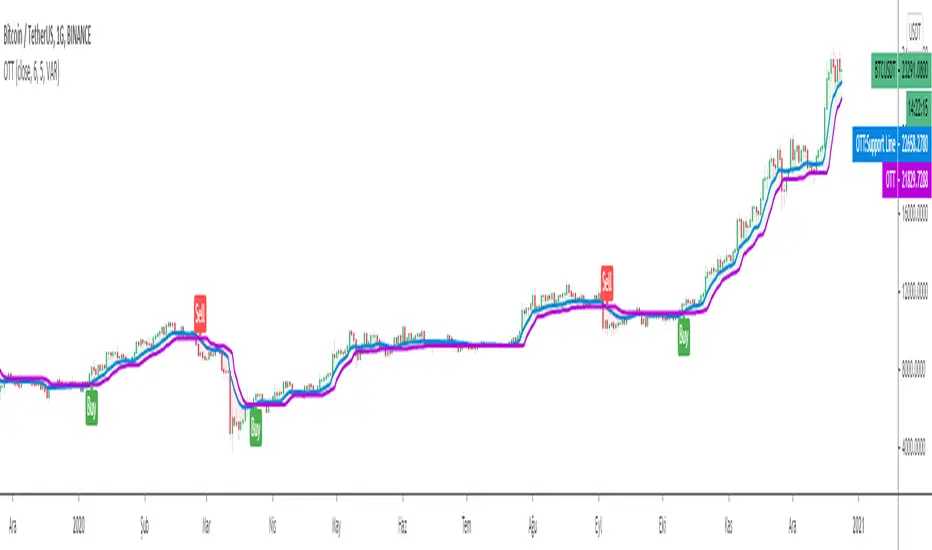
Optimized Trend TrackerA brand new indicator from the developer of MOST (Moving Stop Loss) indicator Anıl Özekşi.
Optimized Trend Tracker OTT is an indicator that provides traders to find an existing trend or in another words to ser which side of the current trend we are on.
We are under the effect of the uptrend in cases where the prices are above OTT ,
under the influence of a downward trend, when prices are below OTT
it is possible to say that we are.
The first parameter in the OTT indicator set by the two parameters is the period/length.
OTT will be much sensitive to trend movements if it is smaller. And vice versa, will be less sensitive when it is longer.
As the period increases it will become less sensitive to little trends and price actions.
In this way, your choice of period, will be closely related to which of the sort of trends you are interested in.
The OTT percent parameter in OTT is an optimization coefficient. Just like in the period
small values are better at capturing short term fluctuations, while large values
will be more suitable for long-term trends.
In addition, when OTT is used with the support line in it, buy and sell signals
it will become a producing indicator.
You can use OTT default alarms and Buy Sell signals like:
1-
BUY when Prices are above OTT
SELL when Prices are below OTT
2-
BUY when OTT support Line crosses over OTT line.
SELL when OTT support Line crosses under OTT line.
3-
BUY when OTT line is Green and makes higher highs.
SELL when OTT line is Red and makes lower lows.
Note: A small coverage with English subtitles will be available on my Youtube Channel soon.
EMA Slope Cross Trend Follower StrategyThis strategy uses the cross of the slopes of two EMAs having different lengths to generate trend follower signals. By default, I use 130 and 400, which behave very well.
The conditions which make the strat enter the market are:
- Fast Slope > Slow Slope and price > EMA 200 : go Long
- Fast Slope < Slow Slope and price < EMA200 : go Short
The simple slopes cross in the opposite direction, closes the position.
The strategy performs best on Bitcoin and the most liquid and capitalized Altcoins, but works greatly on volatile assets as well, in particular if they often go trending.
Works best on 4h time frame.
There's also an optional Volatility filter, which opens the position only if the difference between the two slopes is more than a specific value, which can be set in the strategy inputs. The purpose is not opening positions if price is going sideways and the noise is way > than the signal.
Enjoy it!
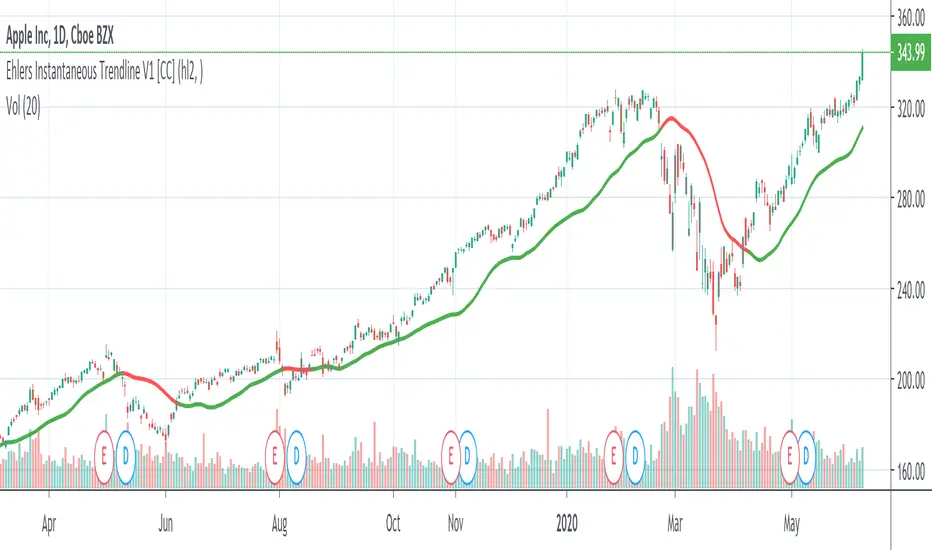
Ehlers Instantaneous Trendline V1 [CC]The Instantaneous Trendline was created by John Ehlers (Rocket Science For Traders pgs 109-110) and this indicator is perfect for determining the medium to long term trend. Buy when the indicator line is green and sell when it is red. I will be introducing a different version of this indicator which is perfect for short term trends so these will pair great together.
Let me know if there are other scripts you would like to see me publish or if you want something custom done!
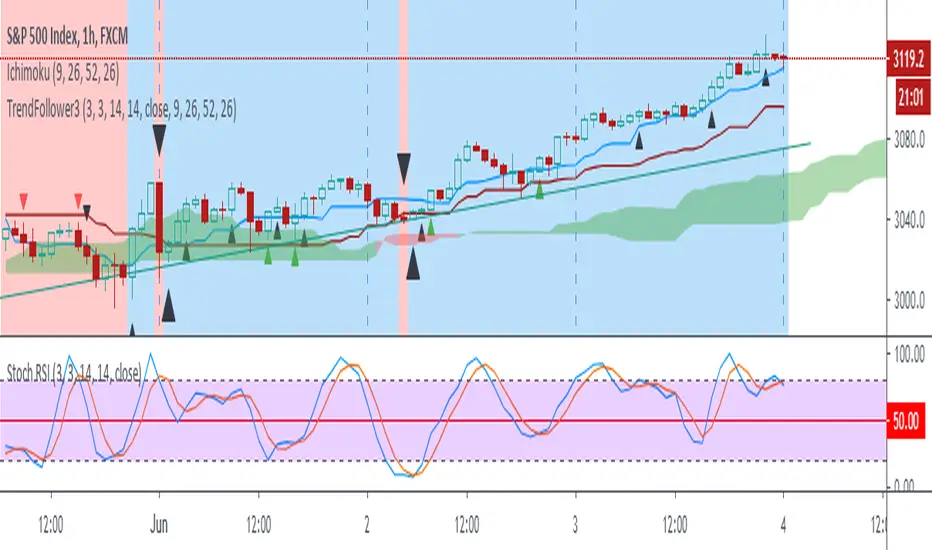
Trend Follow with kijun-sen/tenkan sen for 1 Hour SPX
This script determines, plots and alerts on probable trend initiation and continuation points, using tenkan-sen(conversion line of ichimoku), kijun-sen(baseline of ichimoku) and stochastic RSI, for 1 H SPX.
New long/short trend initiates when prices cross above/below kijun sen. The trend continues when prices cross above/below tenkan-sen or stochastic RSI crosses up/down its signal line, while prices are above/below kijun-sen.
It is good to take partial profit between 10-15 points gain and trail the left with stops below kijun-sen line.
While placing the order, using 2-3 points buffer above/below of signal bars is recommended. Additionally, please be careful about clouds and do not place long/short orders below/above clouds.
Trend Trade ( in W, D, H, 15M )Condition:
Uptrend, EMA5 > EMA8 > EMA13
Downtrend, EMA5 < EMA8 < EMA13
EMA# input can be changed by user.
Trading Plan:
1. Long in Uptrend when Price croseover EMA5;
Buy EMA5 + 0.03 (Do not wait for close), initial stop EMA13-0.03
If it is a big Gap up, do not chase. Let it go;
2. Short in Downtrend when Price croseunder EMA5;
Short EMA5 - 0.03 (Do not wait for close), initial stop EMA13+0.03
If it is a big Gap Down, do not chase. Let it go;
3. No target strategy in this study;
Back test Weekly, daily, hourly, 15M chart for ES1!, CL1!, GC1!, SPY, QQQ, TLT, IWM, XLF, XLK, XOP, GS, IBM, APPL, AMD, MMM, WBA
When side way move, Entry could be stopped quickly with small loss;
When entry in trending move, the position could be hold for a good range, and keep adding to winner.
Using this study, Futures and ETFs are better than single stock. Big Gap can break the trend, and trigger big stop loss;
This study is designed to join an existing trend. Try not use this in the time frame below 15 min.
To catch the turning point of a swing, Price action (Demand/Supply Confirmation) and trendlineBreak could be more accurate than EMA/SMA lines.
Automatic TrendlinesIntroduction
For a full free tutorial explaining this code in more detail, visit the backtest-rookies (.com) website.
This indicator will plot two trend lines at any given time. A resistance trend line and a support trend line. The resistance trend is shown with red circles and is created by joining swing highs together. The second is a support trend which is created by joining swing lows.
Since we need swings to make the trend, the trend line code contains code for the swing detection. You can play around with the swing detection to alter how frequently new trend lines are detected. Relying on swings also means that there will be some delay in trend detection depending on how you configure the swing detection. The higher you set rightbars, the more lag you will have before a trend is detected. However, at the same time the quality of the pivots found will increase. So it is a trade-off you need to come to terms with and decide what the best settings are for you.
Lines
A single trend line is made up of several components.
Pivot Points: Marked as blue or orange circles. There will be two pivots per trend.
Orange/Purple Lines: Connecting all pivot points. You will see these lines change direction slightly each time a new pivot is detected (new circles appear).
Green/Red Circle lines: Showing the trend line from the earliest moment a new trend is detected.
Blue Dashed lines: Joining the purple and green/red circle lines so the full trend line can be seen.
Note: The blue dashed lines use pine-scripts drawing functions. As such, there is a limit to how many of these can be placed on a chart. When the limit is reached, the oldest line will be removed so the newest can be drawn. This means that if you detect enough trends and scroll back in time, the blue dashed lines will disappear at some point!
Trendless MACD Strategy (Trendless Strategy Series -1 )I Try to eliminate the trend of the stock to see a clear version of the indicators. If you have any idea about that topic, you can send a message to me and we can improve this idea together.
HMA-Kahlman Trend & TrendlinesThis script utilizes two modules, Trendlines module (by Joris Duyck) and HMA-Kahlman Trend module. Trendlines module produces crossovers predictive of the next local trend.
Trend Channel [Gu5]SMA 200 determines the trend
Bullish trend, green candles. Down trend, red candles.
If the market value is narrow to the SMA200 channel, yellow candles.
Setting recommended for SMA Range
BTCUSD = 100
EURUSD = 1000
SPX = 100
ETHUSD = 10
Adaptive Trend & SL SystemAdaptive Trend & Risk System
1. The Problem: "Naked" Signals
Most trend indicators on TradingView have a fatal flaw: they tell you when to enter, but they never tell you when to leave . They give you a "Buy" signal, but leave you guessing about where to place your Stop Loss or where to take profit.
A signal without a risk management plan is not a strategy—it's a gamble.
2. The Solution: A Complete Trading System
The Adaptive Trend & Risk System (ATS) is designed to be a complete "Turnkey" trading suite. It doesn't just generate signals; it manages the entire lifecycle of the trade.
It combines three distinct market concepts into one clean overlay:
Trend Detection: Uses a Hull Moving Average (HMA) baseline to determine the immediate market flow.
Signal Filtering: Uses the Average Directional Index (ADX) to filter out "fakeouts" and weak trends.
Dynamic Risk Management: Automatically calculates Volatility-Based (ATR) Stop Losses and Risk:Reward targets the moment a signal is generated.
3. How It Works (The Math)
The script operates on a strict "State Machine" logic. It remembers the state of your trade bar-by-bar.
The Entry (Strong Signals)
A "STRONG" signal is only generated when two conditions are met:
Price crosses the Trend Baseline.
ADX (Trend Strength) is above the threshold (Default: 25).
Note: Weak signals (small triangles) are shown when price crosses the baseline but ADX is low. These are risky and should be treated with caution.
The Stop Loss (Red/Green Crosses ++++)
Upon a strong entry, the script calculates a Stop Loss based on the Average True Range (ATR).
Long SL: Low - (ATR * Multiplier)
Short SL: High + (ATR * Multiplier)
The "Hard" Stop: Unlike trailing stops that move every bar, this SL is fixed to the volatility at the moment of entry. It only disappears if price hits it (marked by an Orange X ) or if a reversal signal occurs.
The Targets (Blue/Purple Dots oooo)
The script projects two Take Profit levels based on your risk:
TP1 (Blue Dots): 1.5x your Risk.
TP2 (Purple Dots): 3.0x your Risk.
Smart Visuals: If price hits TP1, the dots disappear to keep your chart clean, letting you focus on TP2.
4. How to Use This Indicator
Step 1: Wait for a "STRONG" Label. Do not trade every crossover. Wait for the large triangle with the text label.
Step 2: Place your Entry at the close of the signal bar.
Step 3: Place your Physical Stop Loss exactly at the level of the Green/Red Crosses .
Step 4: Place Limit Orders at the Blue Dots (TP1) and Purple Dots (TP2) .
Management:
If the Orange X appears, your Stop Loss was hit. Exit the trade immediately.
If a Weak Signal (small triangle) appears against your trade, consider tightening your stops, as momentum may be fading.
5. Settings Guide
Trend Baseline Length: Controls the sensitivity of the trend filter. Higher = Fewer signals, longer trends.
ATR Length: Controls how "volatile" the Stop Loss calculation is.
Stop Loss Multiplier: The "breathing room" for your trade. 2.0 is standard. 3.0 is for volatile assets like Crypto.
TP Risk:Reward Ratios: Fully customizable. Default is 1.5R and 3.0R.
Risk Warning & Disclaimer
Trading financial assets involves a high level of risk and may not be suitable for all investors. The content, indicators, and signals provided by this script are for educational and informational purposes only and do not constitute financial, investment, or trading advice.
The "Adaptive Trend & Risk System" is a technical analysis tool based on historical price data and mathematical formulas (ATR, ADX, Hull MA). Past performance is not indicative of future results. Market conditions can change rapidly, and no indicator can guarantee profits or prevent losses.
By using this script, you acknowledge that:
You are solely responsible for your own trading decisions and risk management.
You should never trade with money you cannot afford to lose.
The author of this script assumes no liability for any financial losses or damages incurred from the use of this tool.
Always consult with a qualified financial advisor before making investment decisions.
Mobius Trend Pivot (NPR21 v6)Mobius Trend Pivot (NPR21 v6)
Overview
This indicator identifies trend pivots using higher highs with higher lows (bullish trends) and lower lows with lower highs (bearish trends). Originally created by Mobius (V01.01.29.2019) for ThinkOrSwim, this Pine Script conversion maintains the original logic while fixing critical rendering issues found in previous TradingView versions.
How It Works
The indicator tracks price trends over a user-defined lookback period (default n=5) to establish pivot points. When a valid trend pivot forms, the indicator plots:
Red zone (bearish): Upper pivot line with confirmation level below
Green zone (bullish): Lower pivot line with confirmation level above
White dashed lines: Risk-off levels for position management
Confirmation levels are calculated as a multiple (R_Mult, default 0.7) of the Average True Range at the pivot.
Trading Rules (from Mobius original code)
Entry: Trade when price crosses and closes outside the pivot confirmation line
Risk Management: Use the pivot line itself as your risk point - exit if crossed (avoid hard stops)
Risk-Off: Target an ATR multiple for initial profit taking to achieve a risk-free trade
Stop Management: Move mental stop to break-even once risk-off is achieved
Runner Management: Adjust mental stop to new support/resistance levels as they form
What Makes This Version Different
NPR21 v6 fixes critical bugs present in other TradingView versions:
✅ Consistent transparency - The red/green cloud fills maintain constant 85% transparency and no longer progressively darken over time
✅ No overlapping renders - Eliminated the issue where multiple indicator instances would layer on top of each other, creating visual clutter
✅ Proper memory management - Implements linefill deletion/recreation logic to prevent object accumulation
✅ Clean visual display - Matches the original ThinkOrSwim appearance with professional-looking zones
Key Features
Automatic pivot detection based on price structure
Dynamic support/resistance zones
Built-in risk management levels
Alert capability for pivot confirmation crossovers
Minimal lag - responds quickly to trend changes
Works on all timeframes and instruments
Settings
n (default 5): How many bars to look back for trend confirmation
R_Mult (default 0.7): Adjusts how far the confirmation lines sit from pivots
Lower n = more sensitive, more signals
Higher n = less sensitive, fewer signals
Color Scheme
Red lines/zones: Bearish pivots and short trade setups
Green lines/zones: Bullish pivots and long trade setups
White dashed lines: Risk-off target levels
Best Practices
Use 2+ contracts to implement the risk-off strategy
Combine with price action and volume for confirmation
Adjust n and R_Mult based on instrument volatility
Works best on liquid futures and forex pairs
Consider using higher timeframes for swing trades
Credits
Original indicator concept and logic: Mobius (ThinkOrSwim, January 2019)
Pine Script conversion and optimization: NPR21
Note: This indicator is for educational purposes. Past performance does not guarantee future results. Always practice proper risk management and position sizing.
Strict EMA Wick Pullback Trend ContinuationThis script is a strict EMA pullback entry model
designed exclusively for trend continuation traders.
It does NOT attempt to predict tops or bottoms.
It waits for established trends and enters only
on shallow pullbacks with defined risk.
OVERVIEW
This strategy is built for disciplined trend continuation trading.
It looks for shallow pullbacks into a fast EMA during established uptrends
and exits when trend structure breaks.
There is no counter-trend logic and no optimization for win rate.
ENTRY LOGIC
A long entry is triggered when:
• Price pulls back into the fast EMA area (wick touch)
• The pullback remains above the slow EMA (trend integrity)
• The candle closes bullish
• Optional: slow EMA is rising (trend filter)
RISK MANAGEMENT
• A dynamic stop is placed just below the fast EMA
• The stop only tightens — it never loosens
• Losses are small and predefined
• The system is designed to be scaled via position sizing
EXIT LOGIC
• Positions are closed when the fast EMA crosses below the slow EMA
• This represents a breakdown of trend continuation structure
WHAT THIS STRATEGY IS
• A trend continuation entry module
• Risk-first by design
• Low win-rate, high payoff profile
• Designed for trending markets
WHAT THIS STRATEGY IS NOT
• Not a reversal system
• Not a scalping strategy
• Not a signal service
• Not optimized for ranging markets
• Not a promise of profitability
IMPORTANT NOTES
• Long-only by design (BTC context)
• No repainting logic
• Best used with higher-timeframe trend confirmation
• This is a tool, not financial advice
Recommended markets: BTCUSD / BTCUSDT
Timeframe: 1D
Trend filter: ON
Risk: fixed % per trade (user-defined)
Multi Asset & Multi Timeframe Trend DashboardOverview
The Multi-Asset & Multi-Timeframe Trend Dashboard is a comprehensive visual data terminal designed to provide a bird's-eye view of market sentiment across five different assets and seven distinct timeframes simultaneously. By consolidating 10 core technical indicators into a single table, it eliminates the need for "chart hopping" and helps traders identify high-probability trend alignment.
How It Works
The dashboard evaluates each asset based on a Scoring System ($-10$ to $+10$). For every timeframe, the script analyzes the following 10 conditions:
Trend: EMA 20 > EMA 50Macro
Trend: EMA 50 > EMA 200
Position: Price > EMA 200
MACD: MACD Line > Signal Line
MACD Momentum: MACD Histogram > 0
RSI Momentum: RSI(14) > RSI SMA(14)
RSI Level: RSI(14) > 50
Stochastics: Stoch K > D
CCI: Commodity Channel Index > 0
Awesome Oscillator: AO > 0
Visual Logic & Features
Indicator Dots (■): Represent the 10 individual technical conditions. Green indicates a bullish state; Red indicates a bearish state.
Trend Arrows (▲/▼): Displays the aggregate directional bias of a timeframe based on the sum of the 10 dots.
Neutral State (✖): If indicators are split 50/50 (Score of 0), a grey cross is displayed to indicate total market indecision.
"ALL" Column: A macro-summary that aggregates scores across all four primary timeframes.
Volatility Marker (•): A dot appearing next to the symbol name indicates that current ATR is higher than the historical average (user-defined threshold).
Market Status Color: The symbol name background turns Green if the market is currently open and active, and Red if it is closed or stagnant.
Technical Implementation
This script utilizes request.security calls to fetch data across timeframes. To ensure performance and prevent repainting issues, all security calls are handled using the barstate.islast flag to only render the dashboard on the most recent bar.
How to Use
Alignment Trading: Look for "Full House" scenarios where all arrows (15m through Daily) are the same color.
Scalping Bias: Use the "Mini Timeframes" (1m, 3m, 5m) to find entries that align with the higher timeframe trend shown in the main table.
Volatility Filter: Only take trades when the volatility marker (•) is active to ensure there is enough "power" in the move.
EMA Trend Reversal (Regime Change)EMA Trend Reversal (Regime Change)
This indicator highlights EMA slope reversals that often coincide with trend or regime shifts, using a simple two-stage visual system.
It is especially effective on higher timeframes (Daily / Weekly) for swing trading and trend-bias awareness.
Detailed User Guide
What the signals mean
Confirmed signals (dots)
Green dot below price
- EMA slope has confirmed upward (bullish regime shift)
Red dot above price
- EMA slope has confirmed downward (bearish regime shift)
Confirmed dots only appear after the candle closes.
Unconfirmed signals (triangles)
Yellow triangle below price
- EMA is turning up intrabar (not yet confirmed)
Yellow triangle above price
- EMA is turning down intrabar (not yet confirmed)
Unconfirmed signals may repeat at a set interval until confirmation.
Alerts
This script provides two alerts:
EMA Reversal UP
EMA Reversal DOWN
Each alert can fire on:
Initial unconfirmed reversal
Reminder interval while unconfirmed
Final confirmed reversal
Alerts will NOT fire unless this indicator is active on at least one chart.
It may be kept on a chart you do not actively trade.
Settings
EMA Length (default: 21)
Reminder interval (minutes)
Show / hide unconfirmed triangles
Show / hide confirmed dots
Dot transparency
Colors (locked to preserve signal meaning)
Best use cases
Identifying trend or regime changes
Weekly swing trade entries and exits
Holding-period guidance during trends
Alert-based monitoring without watching charts
This is not a scalp or oscillator signal.
It works best when combined with structure, support/resistance, or higher-timeframe context.
Disclaimer
This indicator is provided for educational and informational purposes only.
It does not constitute financial, investment, or trading advice.
All trading involves risk. Use at your own discretion.
Liquidity Trend Horizon [Pineify]Pineify - Liquidity Trend Horizon
The Liquidity Trend Horizon is a sophisticated trend-following indicator designed to identify potential liquidity sweep zones while providing clear visual trend direction. It combines adaptive volatility bands with smart liquidity detection to help traders spot high-probability reversal points where institutional activity may be occurring.
Key Features
Dynamic trend baseline using WMA and EMA smoothing
ATR-based volatility bands that adapt to market conditions
Automatic liquidity sweep detection with visual alerts
Gradient-filled channels for intuitive trend visualization
Real-time candle coloring based on trend direction
How It Works
The indicator calculates a weighted moving average (WMA) of the closing price, then applies exponential smoothing (EMA) to create a responsive yet stable baseline. This dual-smoothing approach filters out market noise while maintaining sensitivity to genuine trend changes.
Volatility bands are constructed using a 200-period Average True Range (ATR) multiplied by a user-defined factor. This creates dynamic support and resistance zones that automatically widen during volatile periods and contract during consolidation.
How Multiple Indicators Work Together
The synergy between WMA, EMA, and ATR creates a comprehensive trend analysis system:
The WMA provides the initial trend estimation with emphasis on recent price action
The EMA layer adds smoothness to reduce false signals
The ATR bands define probabilistic boundaries where price is likely to find support or resistance
Trading Ideas and Insights
Liquidity sweeps occur when price wicks beyond the volatility bands but closes back within the channel. These events often indicate:
Stop-loss hunting by larger market participants
False breakouts that may lead to reversals
Areas of accumulated liquidity being absorbed
A bullish sweep (wick below lower band, close above) suggests potential buying opportunity. A bearish sweep (wick above upper band, close below) may signal selling pressure.
Unique Aspects
Unlike traditional channel indicators, the Liquidity Trend Horizon specifically identifies sweep events where price temporarily breaks boundaries before reverting. This behavior is commonly associated with institutional order flow and smart money concepts.
How to Use
Observe the baseline color for overall trend direction (cyan for bullish, purple for bearish)
Watch for sweep markers (🚀 BULL / 📉 BEAR) at band extremes
Use background flashes as immediate alerts for sweep events
Consider entries when sweeps align with the prevailing trend direction
Customization
Trend Period - Adjust baseline sensitivity (default: 24)
Channel Width Multiplier - Control band distance from baseline (default: 2.0)
Smoothness - Fine-tune signal responsiveness (default: 5)
Color Settings - Personalize bullish/bearish colors and transparency
Conclusion
The Liquidity Trend Horizon bridges technical analysis with liquidity concepts, offering traders a unique perspective on market structure. By highlighting potential sweep zones within an adaptive trend framework, it helps identify areas where reversals are statistically more likely to occur.
London Session Counter-Trend Strategy
👉 Timeframe: 15 minutes
🕗 Phase 1 — Morning Market Reading
Between 8:00 and 9:00, we observe the dominant market direction.
This direction is considered structural for the rest of the trading day.
If this movement continues until 10:00, it is also validated until a clear pullback occurs.
➡️ Therefore:
8:00–9:00 (and possibly until 10:00) = analysis zone
📐 Phase 2 — Trendline Construction
We draw a dashed trendline based on:
the lowest point if the 9:00 trend is bullish
the highest point if the 9:00 trend is bearish
This trendline acts as a key reference level.
🔄 Phase 3 — Trade Setup
We do NOT trade in the direction of the 8:00 trend.
Instead, we wait for:
a price retracement back to the trendline
Then:
we enter a position in the opposite direction of the 8:00 trend
👉 This is a counter-trend strategy, but a structural and rule-based one — not emotional.
Trend Force Index (HTF Momentum)📌 Description
Trend Force Index • HTF Momentum (TFI-HTF) is a market context and trend-strength indicator designed to help traders understand directional force, momentum quality, and higher-timeframe bias.
This tool measures directional impulse and trend pressure using a dual-average force model, normalized by volatility. Instead of producing buy or sell signals, it focuses on how strong a move is, which side controls the market, and whether price is in a trending or compressing state.
🔍 What This Indicator Shows
Directional Force: Identifies bullish, bearish, and neutral force zones
Momentum Quality: Differentiates strong trends from weak or fading moves
Compression Zones: Highlights low-force environments where trades are often lower quality
Higher-Timeframe Context (HTF): Displays directional bias from a higher timeframe for alignment
Volatility Normalization: Adapts to changing market conditions using ATR
🧭 How to Use
Use force direction to confirm price action or structure-based setups
Trade in alignment with HTF bias for higher-probability context
Avoid entries during compression / low-force zones
Best used alongside price action, market structure, VWAP, or support & resistance
🎛 UI Presets
PRO Mode: Clean, subdued visuals for experienced traders
BEGINNER Mode: Higher contrast visuals for easier interpretation
⚠️ Important Notes
This indicator does NOT generate buy or sell signals.It is intended for analysis, confirmation, and market context only. Always combine with your own trading plan and risk management
⚠️ Disclaimer
This indicator is provided for educational and analytical purposes only.It does not constitute financial advice or trade recommendations.All trading decisions and associated risks remain the sole responsibility of the user.Past market behavior does not guarantee future results.
Adaptive Kinetic Trend [AKT] Pure MathTitolo: Adaptive Kinetic Trend - Pure Math
Descrizione:
Overview The Adaptive Kinetic Trend is a custom-built trend following system designed to filter noise and adapt to changing market volatility. Unlike standard indicators that rely on a static calculation, the AKT introduces a "Kinetic" component that adjusts the trend baseline according to price velocity (Momentum) and market intensity (ADX).
The "Pure Math" Implementation To ensure maximum stability and prevent potential discrepancies associated with data gaps or library updates, this script features a 100% manual mathematical library. It does not use TradingView's native ta.* functions for its core logic. Every calculation—including Wilder's Smoothing (RMA), Weighted Moving Averages (WMA), and True Range (TR)—is computed explicitly within the code from raw price data. This provides a transparent look at how the signals are derived.
Key Features
1. Kinetic Center Line The backbone of the indicator is an adaptive moving average that shifts its sensitivity based on a manually calculated RSI (Velocity).
High Velocity: The line reacts faster to capture breakout momentum.
Low Velocity: The line smooths out to prevent whipsaws during corrections.
2. Dynamic Volatility Expansion Using a custom ADX calculation (Intensity), the bands automatically expand during high-volatility events. This helps keep positions open during strong trends where standard ATR stops might be triggered prematurely.
3. Visual Filters (Color Logic) The script uses a strict color-coding system to guide analysis:
🟢 Green / 🔴 Red (Trend): The market is in a validated trend phase with sufficient intensity.
⚪ Gray (Choppy Filter): When Intensity falls below the threshold (default 20), the bars turn gray and signals are suppressed. This filters out low-probability ranging markets.
🟡 Yellow (Proximity Zone): When price trades within 0.5 ATR of the trend line, bars turn yellow. This indicates price is testing the trend structure.
4. Smart Pullback Signals (PB) Small triangles labeled "PB" appear when the price retraces to test the trend line.
Visual Intensity: The signals feature adaptive transparency. They appear bright during strong trends (High Probability) and faded/transparent during choppy conditions (Lower Probability), helping users filter signal quality visually.
5. Live Dashboard A data panel provides real-time metrics:
Trend Status: BULL, BEAR, or RANGE.
Intensity: Raw ADX value to gauge trend strength.
Dist ATR: The precise distance from the close price to the stop-loss line, measured in ATR multiples.
How to Use
Trend Analysis: Identify the main direction via Green/Red candles.
Filtering: Use the Gray bars to identify periods of low volatility/consolidation where trend strategies typically fail.
Re-entries: Use PB triangles to identify potential continuation points within an existing trend.
Risk Monitoring: Use Yellow bars (Proximity) to monitor price action near the invalidation level.
Disclaimer This script is intended for technical analysis and educational purposes only. It provides a visual representation of market trends based on historical data and does not guarantee future performance.