Adaptive Momentum Channel - [Volume Filter]The Adaptive Momentum Channel with Volume Filter (Adaptive MCVF) is an indicator that utilizes an adaptive RSI to adjust its sensitivity based on the market conditions. The RSI component of the indicator calculates the standard deviation and mean deviation of RSI values and uses these to calculate the adaptive RSI. The volume filter component of the indicator filters the adaptive RSI based on the volume average, allowing the indicator to identify trend changes and filter out market noise.
The indicator plots the upper and lower bands of the Adaptive MCVF, which are calculated by taking the moving average of the filtered RSI and applying an offset based on the standard deviation. A fast moving average is also plotted, which can be used to identify short-term changes in the trend.
The Adaptive MCVF also includes a divergence identification feature, which can be used to identify potential trend changes. The indicator plots regular bullish and bearish divergences, as well as hidden bullish and bearish divergences.
This is a variant of my previous MCVF indicator, this one simply allows you to take the standard deviation of the momentum and use it to make the indicator a bit more adaptive!
I made it protected to hide the standard deviation math and the auto divergence code.
You can always use this indicator by pressing "favorite";)
ค้นหาในสคริปต์สำหรับ "momentum"

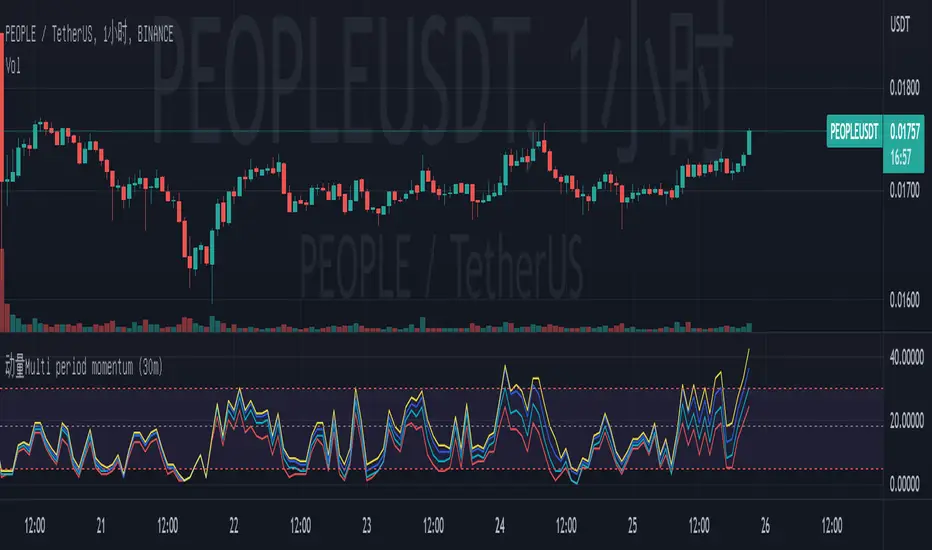
Multi period momentum (30m)I found that when there is oversold or overbought, there is always a good point to buy. Buyers can enter the market after oversold drops or overbought turns. It is recommended not to intervene when overbought or oversold is started, because this may be a deviation.
The basic logic of the strategy is to detect multi period and multi empty conditions. When the multiple or short forces reach an extreme value, we think there will be a good reversal. Based on this, we believe that the best use here is 30m cycle.
I will release the version of multiple cycles in the future. My favorite friends can pay attention to it.
1. Based on multi period resonance;
2. The total score of momentum coefficient is 36, and the lowest score is 0; If the coefficient score is greater than 18, it is a long trend; if the coefficient score is less than 18, it is a short trend. It is recommended to look long if the coefficient score is greater than 18 and short if the coefficient score is less than 10;
3. The closer the momentum coefficient is to the extreme value, the greater the possibility of inversion. Therefore, it can be considered that when it is greater than 30, empty orders can be placed, and when it is less than 5, multiple orders can be placed;
4. This index calculates the resonance coefficient in combination with multiple periods of 5m, 15m, 30m, 1h, 2h and 4h. The most suitable period is 30m, because this period is the middle value;
5. You can use the 30m cycle to look at the overall direction and the 5m cycle to find the exact trading opportunities.
Ripple Momentum Indicator[LeonidasCrypto]Ripple momentum indicator.
This is indicator is not based on any other indicator.
This indicator is a momentum indicator.
How is working?
This indicator is calculating the gap in for each candle and determining the volatility of this candle . Applying WMA average we can get an idea if the volume is coming to the market or not.
Following the same theory as OBV oscillator "Volume will follow the price". This indicator will help to see if the asset is bearish or bullish based on volatility and volume.
How to trade?
Bullish/Bearish divergences
Trends:
Bellow the line 1: the asset should be considered bearish
Above the line 1: the asset should be considered bullish
Longs:
wait for the signal crossing the bands this is telling you the momentum/volume/volatility are expanding.
Shorts:
Wait for the signal crossing below the band. this is telling you the asset is losing momentum/volume/volume are expanding
Band:
This band is acting as dynamic support of resistance.

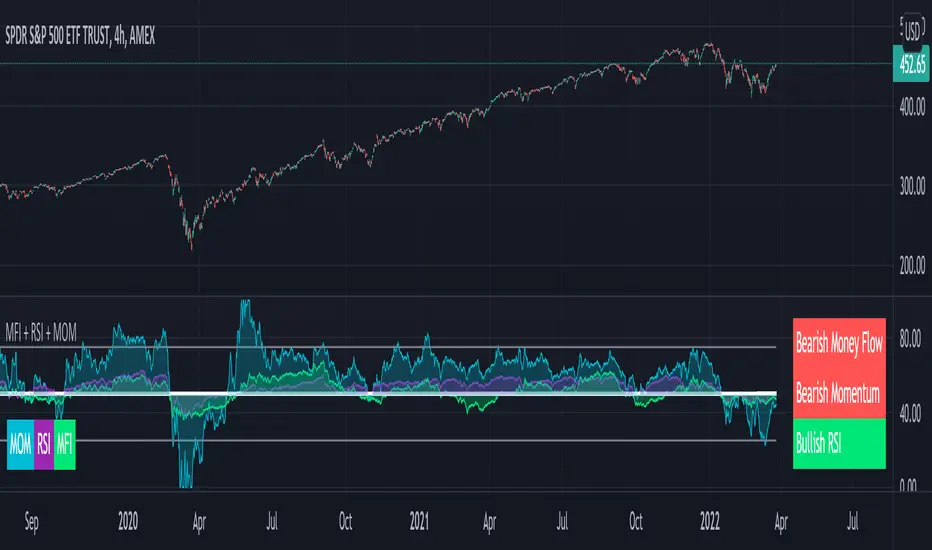
MFI + RSI + MOM With Bull & Bear Trend LabelMOMENTUM + MONEY FLOW INDEX + RELATIVE STRENGTH INDEX WITH BULL & BEAR LABELS
This is a combination of 3 popular indicators. Momentum(MOM), Money Flow Index(MFI) and Relative Strength Index(RSI) along with color changing labels that tell you each indicator's current trend.
The middle white line shows the level that each indicator needs to stay above to be bullish and below for bearish. Watch for all three indicators to cross and hold above or below the mid line for big moves.
It is important to note that these indicators do not need to be going up to be bullish or down to be bearish. They just need to hold above or below the mid line to understand the overall trend.
The momentum indicator is the most relevant in my opinion. If it is holding above the mid line steadily, usually the overall trend will continue upwards so look to buy the dips if the momentum cloud is staying above the white line and vice versa.
It is also important to note that the default settings for this indicator are the 100 period as I find it to be super relevant across most charts but these numbers can be changed in the indicator settings.
Since momentum swings wildly past the normal 0-100 range, it is important to note that the momentum line has been “normalized” to stay within this same range as the rsi and mfi. So if you look at a normal momentum indicator side by side with this indicator it will not look the same however, I find it to be a very good indicator of overall direction so I know the current market sentiment even when price is diverging from the indicator directions.
All of the colors, sources and lengths can be easily customized in the indicator settings input tab.
***HOW TO USE***
When Momentum is above the mid line, it is bullish. When Momentum is below the mid line, it is bearish.
A label on the right side will update in real time to tell you if momentum is Bullish or Bearish for faster recognition of the trend.
When RSI is above the mid line, it is bullish. When Momentum is below the mid line it is bearish.
A label on the right side will update in real time to tell you if RSI is Bullish or Bearish for faster recognition of the trend.
When MFI is above the mid line, it is bullish. When MFI is below the mid line it is bearish.
A label on the right side will update in real time to tell you if MFI is Bullish or Bearish for faster recognition of the trend.
This indicator was built to help you quickly identify the Bullish or Bearish nature of the current trend with a live color changing label so you can glance at the label and understand it's direction without analyzing the indicator data.
***MARKETS***
This indicator can be used as a signal on all markets, including stocks, crypto, futures and forex.
***TIMEFRAMES***
This mom + mfi + rsi indicator can be used on all timeframes.
***TIPS***
Try using numerous indicators of ours on your chart so you can instantly see the bullish or bearish trend of multiple indicators in real time without having to analyze the data. Some of our favorites are our Auto Fibonacci, Directional Movement Index, Volume Profile, Auto Support And Resistance and Money Flow Index in combination with this indicator. They all have real time Bullish and Bearish labels as well so you can immediately understand each indicator's trend.
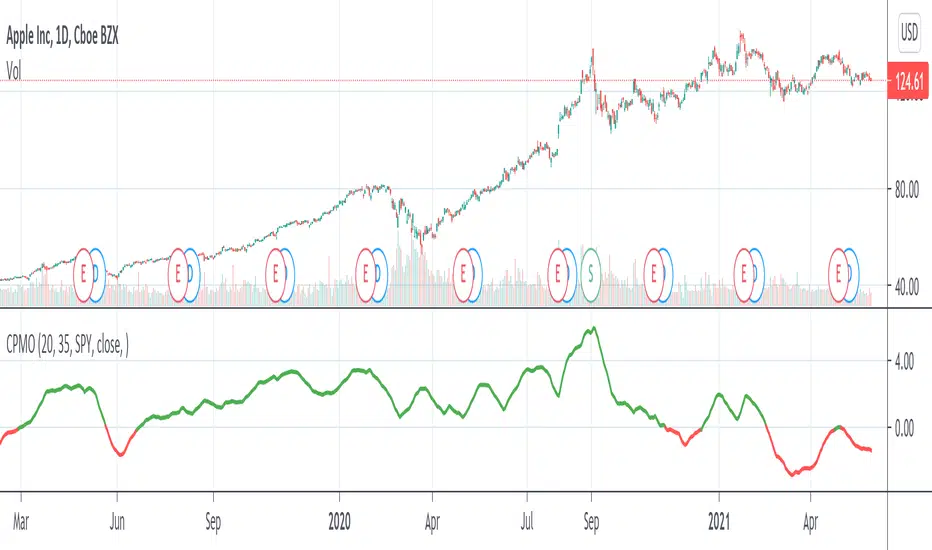
Compare Price Momentum Oscillator [CC]The Compare Price Momentum Oscillator was created by Vitali Apirine (Stocks and Commodities Aug 2020 pg 16) and this is a handy indicator to compare the momentum of the current symbol you are looking at to the s&p to determine the relative strength of the underlying security. Buy when the line turns green and sell when it turns red.
Let me know if there are any other scripts you would like to see me publish!
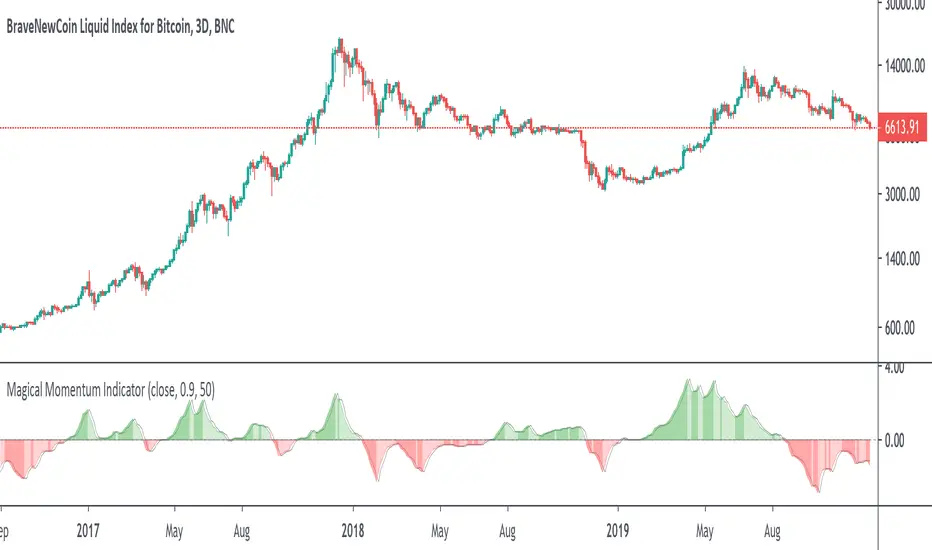
Volume ⨃ αMomentum 🦝🦾First attempt playing around with mixing volume and momentum... I find it to be nonsense, but putting it up for the moment.


Ehlers Smoothed Adaptive Momentum [LazyBear]Bored of Ehlers yet? :) I still have plenty of Ehlers in my collection, was thinking of publishing one of his Fishers or Adaptive RVI next, but @ChartArt requested Smoothed Adaptive Momentum (SAM), so here we go...
This is my 200th script (not including the variations and other custom scripts I shared over PM). My complete list of indicators here - bit.ly
Now, about the indicator :)
This smoothed adaptive momentum is straightforward to use (per Ehlers original rules). If it crosses above zero buy the next open, if it crosses below zero sell the next open. Of course, I strongly suggest filtering the signals.
Finally, here's an Ehlers-only chart to help determine where BTC is heading :P
More info:
- Ehlers CG Oscillator:
- Cybernetic Analysis for Stocks and Futures (Ehlers)
List of my public indicators: bit.ly
List of my app-store indicators: blog.tradingview.com
--Updated chart--
Here's the chart with barcolors ON (forgot to turn it on in the published one)

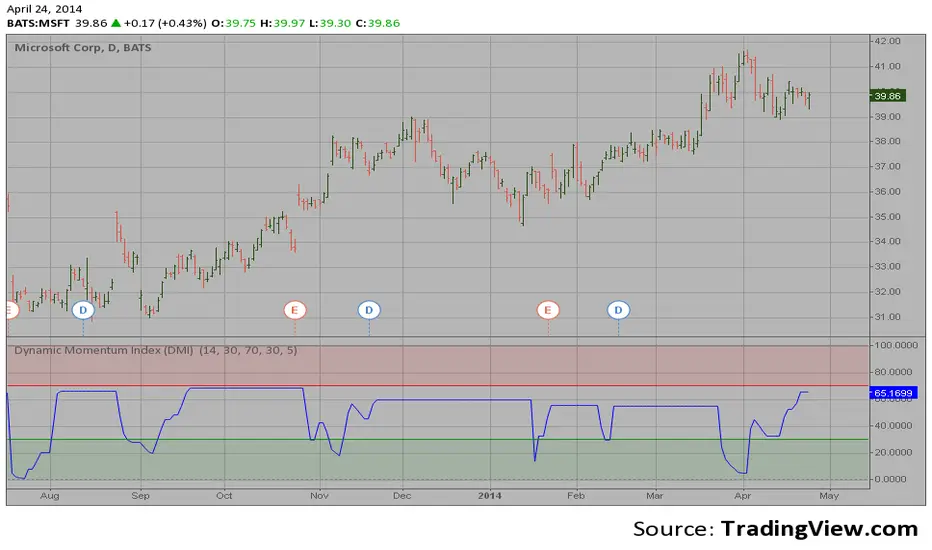
Dynamic Momentum Index (DMI) This indicator plots Dynamic Momentum Index indicator. The Dynamic Momentum
Index (DMI) was developed by Tushar Chande and Stanley Kroll. The indicator
is covered in detail in their book The New Technical Trader.
The DMI is identical to Welles Wilder`s Relative Strength Index except the
number of periods is variable rather than fixed. The variability of the time
periods used in the DMI is controlled by the recent volatility of prices.
The more volatile the prices, the more sensitive the DMI is to price changes.
In other words, the DMI will use more time periods during quiet markets, and
less during active markets. The maximum time periods the DMI can reach is 30
and the minimum is 3. This calculation method is similar to the Variable
Moving Average, also developed by Tushar Chande.
The advantage of using a variable length time period when calculating the RSI
is that it overcomes the negative effects of smoothing, which often obscure short-term moves.
The volatility index used in controlling the time periods in the DMI is based
on a calculation using a five period standard deviation and a ten period average
of the standard deviation.
Market State Momentum OscillatorMarket State Momentum Oscillator (MSMO)
Overview
The MSMO combines three elements in one panel:
Momentum oscillator (gray/blue area with aqua signal line)
Market State filter (green/red background area)
Money Flow Index (orange line)
Works on all markets and all timeframes. Non-repainting at bar close.
Colors and meaning
Gray area: Momentum above 0 (bullish bias)
Blue area: Momentum below 0 (bearish bias)
Aqua line: Signal line smoothing the oscillator
Green background: Market state bullish (price above moving average)
Red background: Market state bearish (price below moving average)
Orange line: Money Flow Index (volume-weighted momentum)
How to use
Always wait for confirmation of the green or red market state before acting.
Trend alignment: Watch the slope of the Weekly and Daily 200 MA and Weekly and Daily 50 MA to understand higher-timeframe trend direction. Trade only in alignment with the broader trend.
Entries:
Long: Green state + gray histogram rising + MFI trending up
Short: Red state + blue histogram falling + MFI trending down
Exits: Histogram crossing back through 0, or state background flips against the position.
Users can add chart alerts on plot crossings if needed.
Inputs
Lengths for oscillator pivot, signal smoothing, state moving average, trend weight, return %, and Money Flow Index. Defaults work for most charts.
Note
Educational use only. Not financial advice.
Tags
trend, oscillator, market state, momentum, money flow, crypto, forex, stocks, indices, futures

Momentum Trend Strength (MTS) *Julian_Acunja*Momentum Trend Strength (MTS)
The Momentum Trend Strength (MTS) indicator visually represents market momentum directly on your chart. By clearly highlighting momentum direction and intensity, traders can easily recognize shifts in market sentiment and anticipate potential turning points.
Traders can easily adjust the sensitivity and smoothing parameters, making it adaptable to diverse market conditions and trading strategies.
🔹 USAGE
The Momentum Trend Strength indicator helps traders intuitively detect market momentum, enhancing their ability to anticipate and respond dynamically to changing market conditions. Traders typically interpret three main scenarios using this indicator:
🚀 Momentum Acceleration:
An expanding green line above recent price action signals increasing bullish momentum, suggesting buyers are gaining strength. Conversely, a downward-expanding red line below price action indicates stronger bearish momentum, signifying increasing selling pressure.
🔄 Momentum Reversal:
A clear shift from red to green (or vice versa) often signals potential momentum reversals, providing traders with timely indications of possible market turns or shifts in sentiment.
⚖️ Momentum Consolidation:
When the indicator remains near the price line, it suggests weak momentum and potential market consolidation. Traders might interpret this as a range-bound market environment, adjusting their strategies accordingly.
By carefully monitoring these momentum shifts, traders can gain deeper insights into the underlying market dynamics and better prepare for future price movements.
🔹 DETAILS
The indicator’s momentum visualization is presented directly over the current price action, enhancing traders' ability to rapidly interpret momentum without additional chart clutter:
✅ Green Line: Positive momentum (bullish bias).
❌ Red Line: Negative momentum (bearish bias).
The vertical distance between the Momentum Trend Strength line and price visually indicates momentum intensity:
Larger distance: Signifies stronger market momentum.
Smaller distance: Suggests weakening momentum or neutral conditions.
🔹 Interpretation
Key interpretations include:
Bullish Confirmation: Sustained green lines indicate robust buying activity and confirm bullish trends.
Bearish Confirmation: Persistent red lines suggest strong selling pressure and validate bearish market sentiment.
Early Reversal Signals: Color transitions alert traders to potential market reversals, providing early opportunities to reassess trades.
🔹 Practical Application
Traders commonly integrate Momentum Trend Strength (MTS) into their broader trading strategies by:
Confirming directional trends alongside price action analysis.
Identifying optimal trade entry and exit points during momentum shifts.
Reducing market noise through customizable smoothing, enhancing clarity of momentum signals.
🔹 SETTINGS
📌 Momentum Parameters
Length: Adjusts sensitivity for momentum detection, influencing how quickly momentum shifts are identified.
EMA Smoothing: Determines the level of noise filtering, balancing signal responsiveness and smoothness.
📌 Visualization
Automatic color adaptation clearly signals bullish or bearish momentum.
Simple default visualization settings optimize usability for traders across various markets and timeframes.
🔹 ADDITIONAL NOTES
The Momentum Trend Strength (MTS) indicator provides traders with a straightforward yet powerful visualization of momentum directly on the price chart. Its intuitive nature and adaptive settings make it a valuable addition to various trading approaches and analytical methods, helping traders confidently interpret market movements and momentum dynamics in real-time.

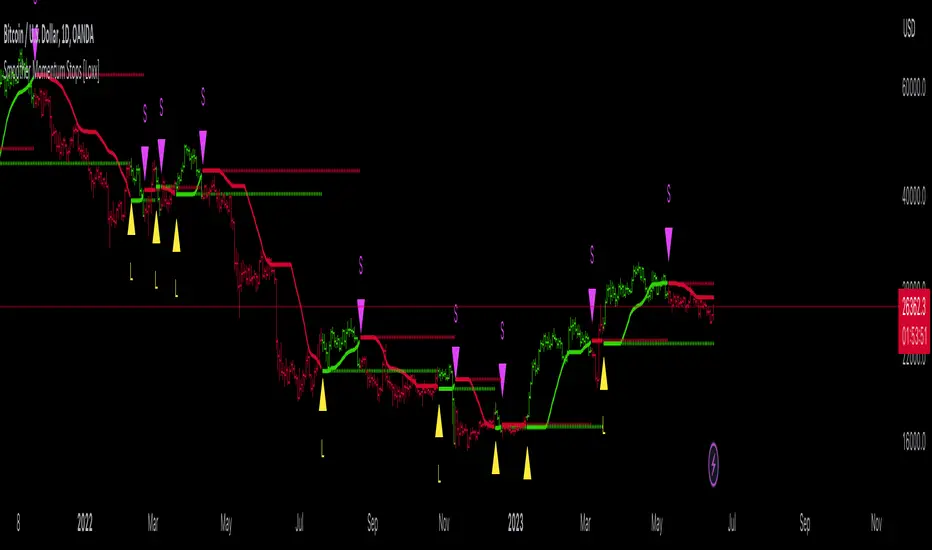
Smoother Momentum Stops [Loxx]Smoother Momentum Stops (SMS) is a dynamic tool that combines the logic of momentum and moving averages to create an overlay of the market price and generate potential trade signals. The original idea for this indicator comes from the beloved and esteemed trading indicator guru Mladen Rakic.
Understanding the Framework
The SMS incorporates various aspects of technical analysis, including momentum calculation, several types of moving averages, and an intelligent stop-and-reverse system that determines when to enter and exit trades.
The indicator initiates by defining the color scheme for visualization, specifically green for bullish trends and red for bearish trends. It further utilizes the 'smmom' and 'fema' functions to calculate smoothed momentum and fast exponential moving averages, respectively. The values computed by these functions are central to the signal generation process.
Momentum Calculation
The 'smmom' function serves to calculate a smoother momentum by taking a source (such as the closing price) and a period as inputs. This function employs a complex algorithm involving exponential moving averages (EMA), wherein two EMAs are calculated with different smoothing factors, and the difference between the two results is returned as the output. This smooth momentum calculation assists in eliminating unnecessary noise from the market and delivers more reliable momentum readings.
Moving Averages Computation
One key feature of the SMS is the ability to select from five different moving average types: Exponential Moving Average (EMA), Fast Exponential Moving Average (FEMA), Linear Weighted Moving Average (LWMA), Simple Moving Average (SMA), and Smoothed Moving Average (SMMA). The 'variant' function assigns the chosen method to the '_avg' variable, which is then used in the trade signal logic.
Trade Signal Generation
SMS employs a complex yet robust mechanism for generating trade signals. A stop-and-reverse system is established, which works on the principle of momentum. If the smoothed momentum is positive, an upper stop is determined and if the momentum is negative, a lower stop is defined.
The process continues by defining long and short entry conditions. The indicator goes long when an upper stop exists, and the previous bar had a lower stop, signifying a shift in momentum. The short entry condition is the opposite: the indicator goes short when a lower stop exists, and the previous bar had an upper stop. Alerts are generated for each of these conditions, helping traders to take timely action.
Visual Representation and UI Options
In terms of visual representation, the indicator plots upper and lower stops, employing green color for upper and red for lower stops. If the option to color bars is chosen, the entire bar is colored green or red, based on whether an upper or lower stop exists. This feature allows traders to visually comprehend market conditions better. Support and reisstance levels are also provided for visual context.
Conclusion
The Smoother Momentum Stops indicator is a potent tool for traders seeking to optimize their trading strategies. It blends the fundamentals of momentum and moving averages, resulting in a robust system that provides clear, reliable, and timely trading signals. By adjusting the smoothing type and period parameters, traders can customize the indicator to fit various market conditions and asset types, thereby adding a layer of flexibility to their trading strategies.
The use of a stop-and-reverse system adds a layer of risk management by offering precise entry and exit points based on momentum shifts. These stops are not just mere levels of entries or exits, but they reflect the undercurrent of the market's momentum, thus providing a dynamic framework to make informed trading decisions.
Additionally, the SMS indicator offers visual simplicity. The color-coded bars and distinct symbols for long and short positions make it easier for traders to interpret the signals and market direction quickly. Combined with the alert system, it ensures that traders never miss an important trading opportunity.
Finally, the power of the SMS indicator lies in its adaptability and comprehensive approach. By providing a selection of moving averages and an intelligent momentum-based system, it encapsulates various aspects of market behavior. As such, it is a useful tool not just for momentum traders, but for any trader who understands the significance of moving averages and momentum in predicting market movements.
In conclusion, the Smoother Momentum Stops indicator stands as an innovative, adaptable, and powerful tool for the modern trader. Its blend of flexibility, dynamic risk management, and straightforward visualization offer a comprehensive solution for traders looking to navigate the complex world of financial markets. With a detailed understanding of its workings as presented in this essay, traders can harness its full potential to optimize their strategies, manage risk, and achieve their trading objectives.
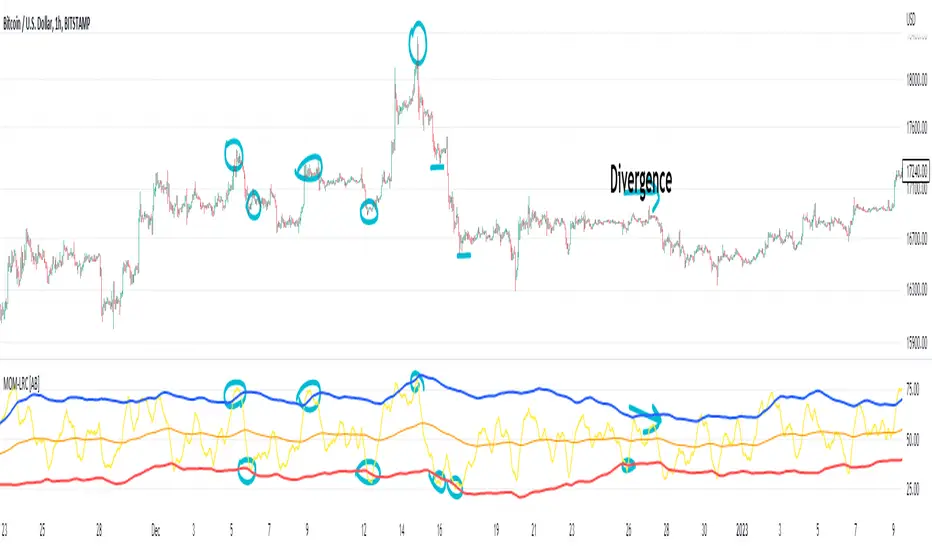
(Very promising) [Abdullah Ahmed] Momentum indicator V.1Description: MOM-LRC is a powerful technical analysis indicator designed to provide traders with signals based on the momentum of an asset's price and its deviation from its mean value. The indicator calculates the exponential RSI and uses a custom function to determine the percentage change from the mean. The upper and lower bands of the momentum channel are then calculated using linear regression of the rate of change from the mean. The channel multiplier can be adjusted to increase or decrease the sensitivity of the indicator.
How to use :
1 - Using MOM-LRC , look for buy signals when the price of the asset is below the lower border of the channel and retracing up. The opposite is true in the case of sell signals.
2 - It is also used in the case of negative and positive divergences, just as you use RSI
The indicator can be used on any time frame and any asset, making it a versatile tool for traders of all levels.
features:
Calculates exponential RSI and percentage change from the mean
Uses linear regression to calculate upper and lower bands of momentum channel
Adjustable channel multiplier for increased sensitivity
Suitable for any time frame and any asset
Happy trading!
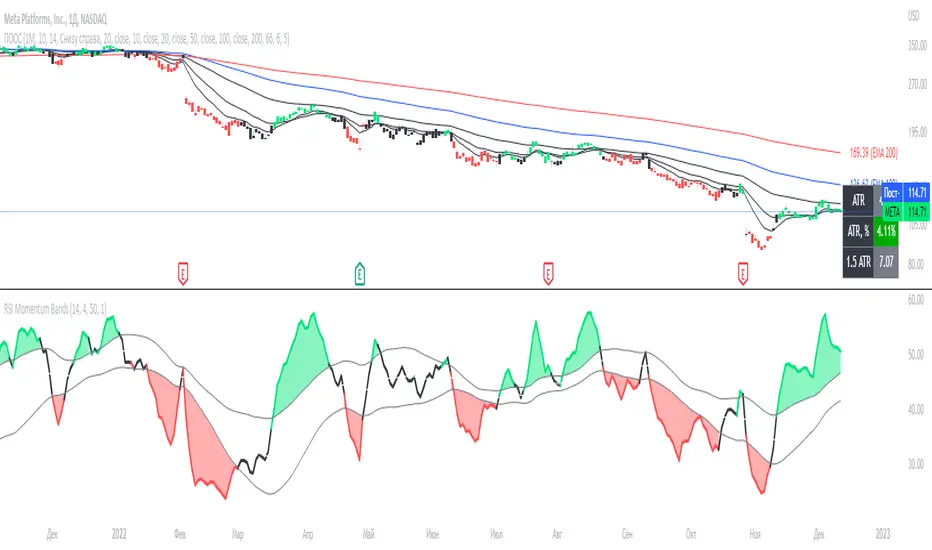
[EDU] RSI Momentum BandsRSI Momentum Bands serve a purpose to find best RSI momentum for entering a trade.
Indicator is built simply:
1st RSI MA is smoothed RSI by little period, 2nd RSI MA is smoothed RSI by a bigger period.
Then we calculate standard deviation from the 2nd MA and make upper and lower band.
The rules for trades are simple:
When RSI is above higher band - Buy ;
When RSI is below lower band - Sell .
The indicator is for educational purposes only to present trades a momentum bands concepts, widely used across professionals.
Hope you will find it helpful.
Take your profits!
- Tarasenko Fyodor
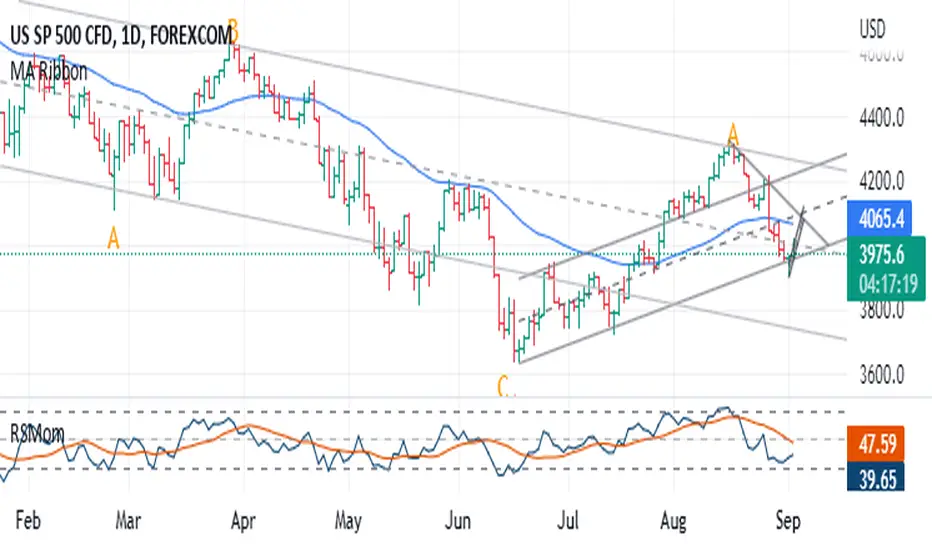
Relative Strength MomentumThe RSI is a traders friend - it can provide insight that other indicators simply cannot. The RSI achilles heel is that it can often fail to highlight divergence. Constance Brown attempted to resolve this problem with the 'Composite index' - a powerful tool. However.. for me, looking at two indicators can get a bit much - especially if viewing multiple time-frames. I want one tool which provides the RSI, it's ranging/reversal behaviour (as documented by Andrew Cardwell) and a better grasp of momentum swings (via divergence and reversal signals). So this is my best effort, and I hope it can prove useful to some of you. At first the differences may be hard to spot - but they are there!
My default settings are optimised - as with the 'normal' RSI you can expect a bullish trend to result in few (if any) moves below 30. In a bearish trend, you can expect few (if any) incursions above 70. Cardwell's observations apply. I recommend using this with a 50 period EMA to provide some additional context.
OBV with Volume/Momentum DivergenceCredits go to vyperphi696 and LazyBear for the original OBV with Divergence script.
This indicator has the new option to check for momentum divergence, which I have done by adding RSI and MACD data.
Hence the indicator allows combined testing of volume and momentum divergence. This feature aims to improve trend reversal detection by reducing false positives.
In summary, 3 divergence categories are shown by default as lines:
Volume + RSI + MACD (dark green/red)
Volume + RSI / Volume + MACD (light green/red)
Volume (gray)
Line colors can be adjusted via plot settings. Therefore it is also possible to distinguish Volume + RSI and Volume + MACD divergence if necessary.
Lastly, I edited the indicator scaling mechanism when changing from one timeframe to another; the transitions are smoother now. This only applies when auto-scaling is off.

Renko - RSI MomentumIn essence this Renko trading system is the following:
1. Momentum based entries
2. Trend trading system (small losses, big wins)
3. As well as a trend continuation system
------------------------------
!IMPORTANT!
------------------------------
- You MUST have a Pro+ account. Why? Cause Renko NEEDS to run on 1min or 5min chart, nothing larger.
If you don't, the chart will repaint .
------------------------------
CHART SETUP
------------------------------
1. Set chart to Renko
2. Set period of chart to 1 min (or 5 min)
3. Set Renko box size method to "Traditional"
4. Set Renko box size to:
- JPY Pairs: 0.2 to 0.4
- Other Major/Minors: 0.002 - 0.004
- Exotic pairs: NO IDEA... (I haven't tested them yet)
5. Load the indicator
------------------------------
RULES
------------------------------
Trend Entry
An arrow will appear the following conditions are met:
LONG: RSI(7) goes above 55 AND price is above the 50 SMA
SHORT: RSI(7) goes below 45 AND price is below the 50 SMA
Enter immediately after the bar is printed.
Counter Trend Entry
An orange dot appears when the following conditions are met:
LONG: RSI(7) goes above 55 AND price is below the 50 SMA and above the 10 EMA
SHORT: RSI(7) goes below 45 AND price is above the 50 SMA and below the 10 EMA
I would not suggest entering immediately but rather finding a trendline or support/resistance that is being broken.
Exit
- Exit when a white bar is printed
- OR use your own discretion. Like 2 bars in opposite direction or on EMA cross or hit of support/resistance.
------------------------------
CHART
------------------------------
- Green bars are when the RSI(7) is above 55.
- Red bars are when the RSI(7) is below 45.
- White bars are when the RSI(7) is between 45and 55.
------------------------------

Edge of MomentumThe script was designed for the purpose of catching the rocket portion of a move (the edge of momentum).
Long
--When RSI closes over 60, take long order 1 tick above that bar. The closed bar above RSI 60 will be colored "green" or whatever color the user chooses. (RSI > 60)
--On a long position, exit will be a closed bar below the ema (low, 10) . The closed bar below the ema will be colored "yellow." (Price < ema)
--Note: On a long position there is no need to exit when a closed bar is colored "purple." RSI is just below 60 but above 40. Pullback or chop
Short
--When RSI closes below 40, take a short order 1 tick below that bar. The closed bar below RSI 40 will be colored "red." RSI<40)
--On a short position, exit will be a closed bar above the ema (low, 10). The closed bar above the ema will be colored "purple." (Price > ema)
--Note: On a short position there is no need to exit when a closed bar is colored "yellow."
Note: You may see a series of purple and yellow bars, that is simply chop. I define chop as RSI moving between 60 and 40.
Trade should only be taken above green colored candle(long) and below red colored candle (short). No position should be taken off yellow or purple candle (chop)
Again this is designed to catch the momentum part of a move, and to help reduce some entries during chop. It is a simple systems that beginning traders can use and profit from.
Note: I don't no shit about coding scripts I just learn from reading others.
Enjoy. If you decide to use please drop me a line...suggestions/comments, etc.
Best of luck in all you do.

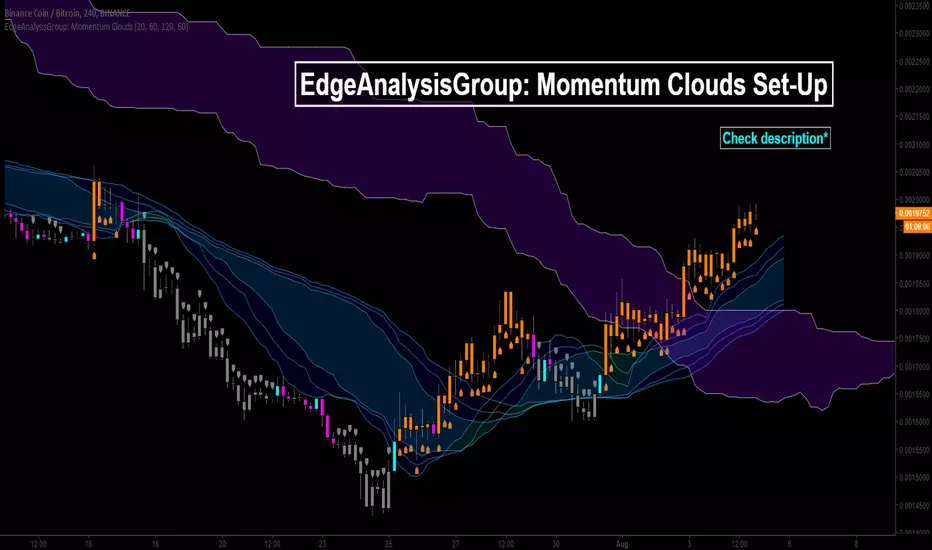
EdgeAnalysisGroup: Momentum Clouds Set-UpWhat do you need turned off and on in the settings to have this exact setup?
Bar colours transparency = 100%
Lagging Span off
Baseline off
Conversion line off
What is it?
This trading strategy is an all in one. This means any additional parameters could make the set-up very noisy. I spent hours developing and back-testing the core of the whole method- volume clouds. The volume cloud is the wavey/much more fluid centralised cloud. These have in essence been left the same with new additions crafted around the volume clouds, the ichi and the momentum indicator. It Uses-
Volume
MA's
Ichimoku Clouds
Displacement
RSI
MACD
Even though your fundamental price action will come into play when using this indicator- it does abstract resistance/support zones and trade zones very nicely to make the overall difficulty of the indicator and trading experience much lesser.
How to trade on it?
Trade edge to edge on the clouds.
Mid-section is safe trade area on volume cloud.
Trade re-tests / rejections. Watching for 3rd retest + for break back into cloud.
Bullish mom + break above vol cloud = Bullish trend.
Bearish mom + break below vol cloud = Bearish trend.
Stoploss is situational.
Example board:
BTC/USD 1 Day.
ETH/BTC 1 Day.
NEO/BTC 4 Hour.
Hopefully from these examples, when observing them you are understanding how the clouds work, and how the momentum ties into the whole model, any questions don't hesistant to comment- and feel free to drop me a follow for my hard work too.
Thank you for reading, I hope this indicator can aid you, as it is doing with a few of my friends and myself.
All information found here, including any ideas, opinions, scripts, views, predictions, forecasts, commentaries, suggestions, or stock/cryptocurrency picks, expressed or implied herein, are for informational, entertainment or educational purposes only and should not be construed as personal investment advice. These are not facts but my personal views and opinions.
I will not and cannot be held liable for any actions you take as a result of anything you read here.
DecisionPoint Price Momentum Oscillator [LazyBear]The DecisionPoint Price Momentum Oscillator (PMO) is an oscillator based on a Rate of Change calculation that is smoothed twice with custom exponential moving averages. Because the PMO is normalized, it can also be used as a relative strength tool.
PMO can be used in many ways:
- PMO can be used to determine the OB/OS state. While the +2.5 to -2.5 is the usual range for broad stock market indexes, each price index will have its own “signature” range. You may have to tune this for your instrument.
- PMO triggers buy/sell on signal crossovers and ZERO crossovers.
- Common patterns like BullKiss, BearKiss are useful to track. See the link below for more info.
- Divergences.
- Histo-only mode that can be used similar to MACD-Histo.
I have exposed all params as configurable. Have fun tuning :) Don't forget to share what you found for your instrument.
More Info:
stockcharts.com
List of my public indicators: bit.ly
List of my app-store indicators: blog.tradingview.com
Some Sample Charts:
TWTR:
MSFT:
GOOGL:

Composite Momentum Index [LazyBear]This is a composite oscillator derived from modified 5/10/20 Chande's Dynamic Momentum Index values.
Volatility is factored in, by design. Look for OB/OS extremes and divergences.
I added the green/red ribbon look to make it easy to read :)
More info:
www.investopedia.com
List of my public indicators: bit.ly
List of my app-store indicators: blog.tradingview.com

