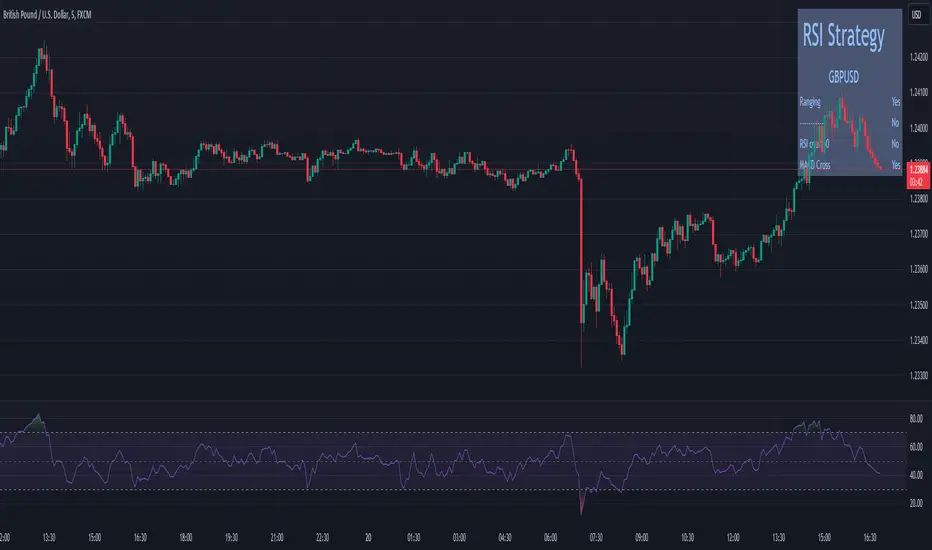
TradersCheckListThe Traders Check List is a unique and innovative tool designed to assist traders in their decision-making process. Unlike traditional indicators that provide signals or visual representations of market data, the Traders Check List offers a structured and customizable checklist that traders can use to ensure they're adhering to their trading plan and strategy.
While there are countless indicators available for trend detection, momentum, volatility, and other market aspects, very few tools focus on the trader's process. The Traders Check List fills this gap by providing a visual reminder of key trading considerations directly on the chart.
Functionality:
Upon applying the Traders Check List to a chart, users will see a table displayed, typically in the top right corner. This table contains rows that represent different trading considerations, such as trend direction, risk management, and psychological factors. Each row can be customized by the user to fit their specific trading plan.
For instance, a trader might have a row labeled "Trending Lower" with a corresponding "Yes/No" column to confirm if the current instrument is indeed trending downward.
Underlying Concepts:
The Traders Check List is based on the principle that successful trading is not just about market analysis but also about discipline and consistency. By having a visual checklist on the chart, traders are constantly reminded of their strategy's key components, reducing the likelihood of impulsive or emotional decisions.
How to Use:
Apply the Traders Check List to your desired chart.
Customize the rows based on your trading strategy's key considerations.
As you analyze the market, update the checklist to reflect the current conditions and your analysis.
Before entering a trade, review the checklist to ensure all criteria are met.
การวิเคราะห์ปัจจัยพื้นฐาน
Smart Money IndicatorSmart Money Indicator
Overview:
The "Smart Money Indicator" is a custom Pine Script indicator designed to help traders identify potential instances of "smart money" or institutional activity in the financial markets. The concept of "smart money" suggests that institutional investors or sophisticated market participants may have an edge due to their access to resources, information, and analytical tools.
Indicator Features:
Volume Moving Average: The indicator calculates a simple moving average (SMA) of the trading volume over a specified length (default is 20 bars). This moving average serves as a baseline for evaluating current trading volume.
Smart Money Signals: The indicator plots green triangles below the price bars when the current trading volume is significantly higher (50% above) than the moving average. This is intended to highlight potential instances of "smart money" activity.
Dumb Money Signals: Conversely, the indicator plots red triangles above the price bars when the current trading volume is significantly lower (50% below) than the moving average. This is meant to indicate potential "dumb money" activity.
How to Use:
Traders can use this indicator to identify potential shifts in market sentiment driven by institutional activity. When the green "Smart Money" triangles appear, it may suggest increased institutional interest or significant trading volume, potentially signaling a noteworthy market event. Conversely, red "Dumb Money" triangles may indicate periods of reduced institutional activity.
Disclaimer:
It's important to note that this indicator is a simplified representation of the concept of "smart money" and should be used in conjunction with other technical and fundamental analysis tools. Trading decisions should not be based solely on this indicator, and thorough research and due diligence are essential before making trading or investment decisions.
Customization:
Traders can customize the indicator by adjusting the length of the volume moving average to match their trading preferences and strategies. Experimentation and fine-tuning may be necessary to optimize its performance for specific markets and timeframes.

Global Central Bank Balance Sheets (USD)Global Central Bank Balance Sheets (USD):
Aggregated:
- FED (Federal Reserve) - United States
- ECB (European Central Bank) - Eurozone
- PBC (People's Bank of China) - China
- BOJ (Bank of Japan) - Japan
- BOE (Bank of England) - United Kingdom
- BOC (Bank of Canada) - Canada
- RBA (Reserve Bank of Australia) - Australia
- RBI (Reserve Bank of India) - India
- SNB (Swiss National Bank) - Switzerland
- CBR (Central Bank of Russia) - Russia
- BCB (Central Bank of Brazil) - Brazil
- BOK (Bank of Korea) - South Korea
- RBZN (Reserve Bank of New Zealand) - New Zealand
- SR (Swedish Central Bank) - Sweden
- BNM (Bank Negara Malaysia) - Malaysia
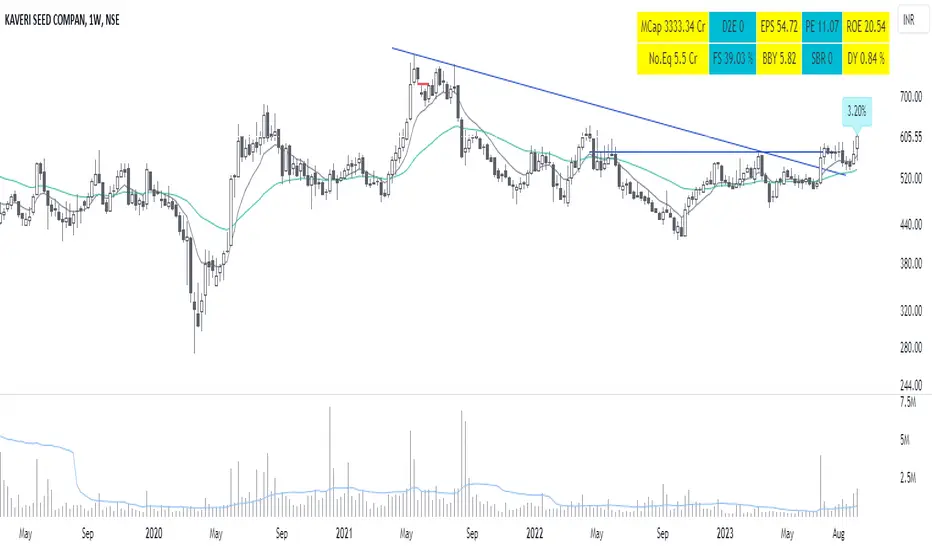
Volume Traded in Total Outstanding Shares with basic fundamentalThis indicator helps to find Volume Traded in Total Outstanding Shares with basic fundamental parameters like MCAP, EPS, PE, D2E and No. Equity shares.
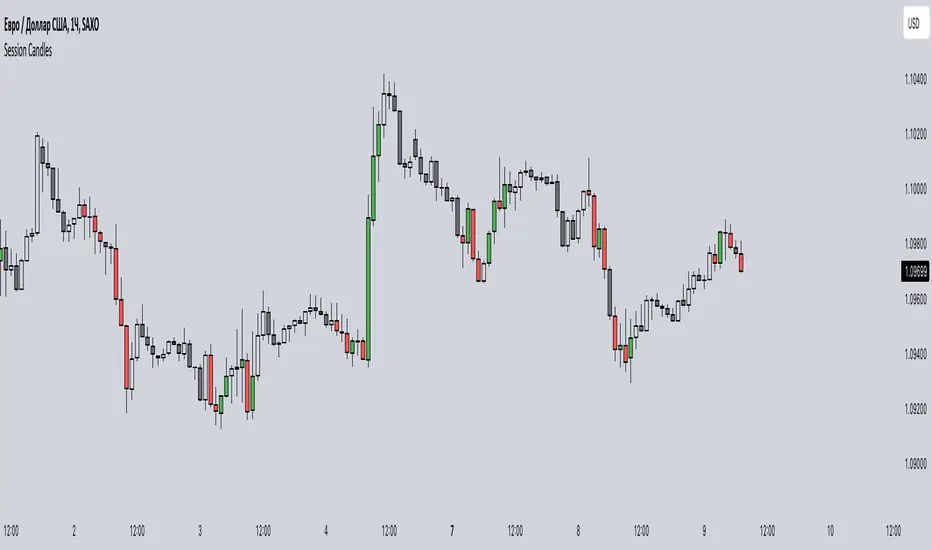
Session CandlesThis indicator is designed to visually represent different trading sessions on a price chart, highlighting candlestick colors to distinguish between bullish (upward movement) and bearish (downward movement) trends during various market sessions. Here's an overview of how the indicator works:
1. Session Definition: The indicator defines four distinct trading sessions:
- London Session: Typically covering the European trading hours.
- New York AM Session: Representing the morning hours of the New York trading session.
- New York PM Session: Representing the afternoon hours of the New York trading session.
- Asia Session: Encompassing the trading hours of the Asian markets.
2. Configuration Options: Users can customize the behavior of the indicator through input options. For each session, users can enable or disable the display of session-specific candles.
3. Candle Coloring: The indicator determines the color of candles based on the following criteria:
- For each session, it checks whether the current candle's closing price is higher than its opening price.
- If the closing price is higher, the candle is considered bullish, and a user-defined green color is used for the candle.
- If the closing price is lower, the candle is considered bearish, and a user-defined red color is applied.
4. Display: The indicator then applies the calculated candle colors to the respective candles of each trading session on the price chart. This visual distinction helps traders quickly identify the prevailing trend during different market sessions.
To use the indicator, traders can overlay it on their price charts in TradingView. By enabling or disabling specific trading sessions, they can focus on the trends and price movements during those specific time periods.
Please note that the actual appearance of the indicator on the chart depends on the user's chosen settings for session enablement and color preferences.
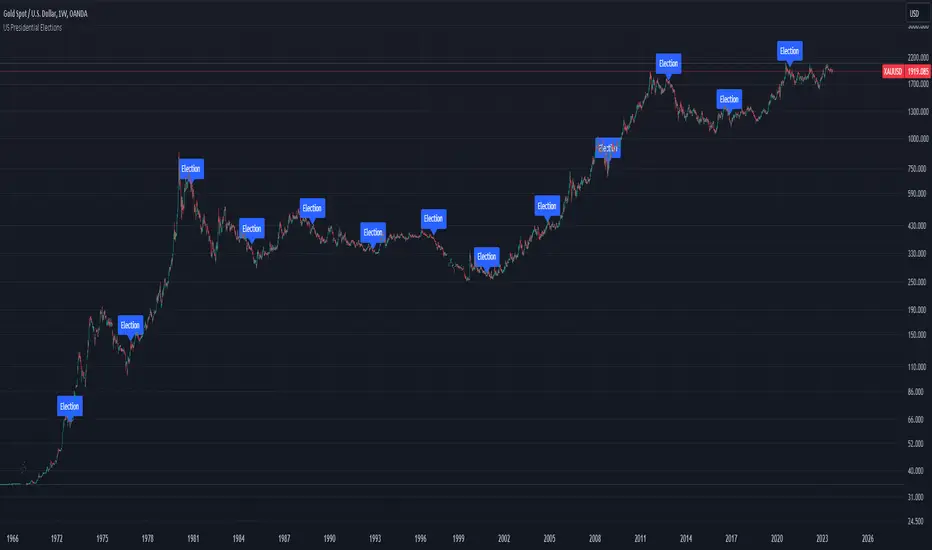
US Presidential ElectionsThis script can be useful in case of analyzing the impact of US presidential election on the past market.
It has separated settings for showing Inauguration and Election labels.
Fundamental Metrics v1.2LETS MAKE FUNDAMENTALS GREAT AGAIN!!!
This is a basic Script to show a list of financial metrics or key performance indicators (KPIs) that are commonly used to assess the financial health and performance of a company.
Let's break down what each of these metrics represents:
1. Long-Term Debt (LTD): This represents the total amount of debt that a company owes that is expected to be paid back over a period of more than one year. It includes bonds, loans, and other long-term borrowing.
2. Ex-Capital Lease: This might refer to the company's obligations related to capital leases, which are long-term lease agreements for assets like equipment or property. "Ex" typically stands for "excluding," so this could be the amount of capital lease obligations excluded from the company's financials.
3. Total Revenue: This is the total income generated by a company from its primary operations. It includes sales of goods or services before any deductions for costs or expenses.
4. Total Equity: This is the total value of ownership or shareholders' equity in the company. It represents the residual interest in the assets of the entity after deducting liabilities.
5. Cash & Equivalents: This refers to the total amount of cash and assets that are easily convertible into cash, such as marketable securities or short-term investments.
6. Revenue Estimates: This could refer to the company's projections or estimates of future revenues, typically for the current fiscal year (FY).
7. Free Cash Flow (FCF): FCF represents the cash generated by a company's operations after deducting capital expenditures (CapEx) required to maintain or expand its asset base. It's a measure of a company's ability to generate cash from its core operations.
8. EBITDA (Earnings Before Interest, Taxes, Depreciation, and Amortization): EBITDA is a measure of a company's operating performance. It looks at earnings before considering the effects of interest, taxes, depreciation, and amortization. It's often used to assess profitability.
9. Market Capitalization (Market Cap): Market cap is the total value of a company's outstanding shares of stock in the stock market. It's calculated by multiplying the current share price by the total number of outstanding shares.
These metrics are essential for investors, analysts, and stakeholders to evaluate a company's financial position, performance, and overall health. They provide insights into various aspects of a company's operations, such as its debt obligations, revenue generation, profitability, and market value. Companies often report these metrics in their financial statements and disclosures to help investors make informed decisions.

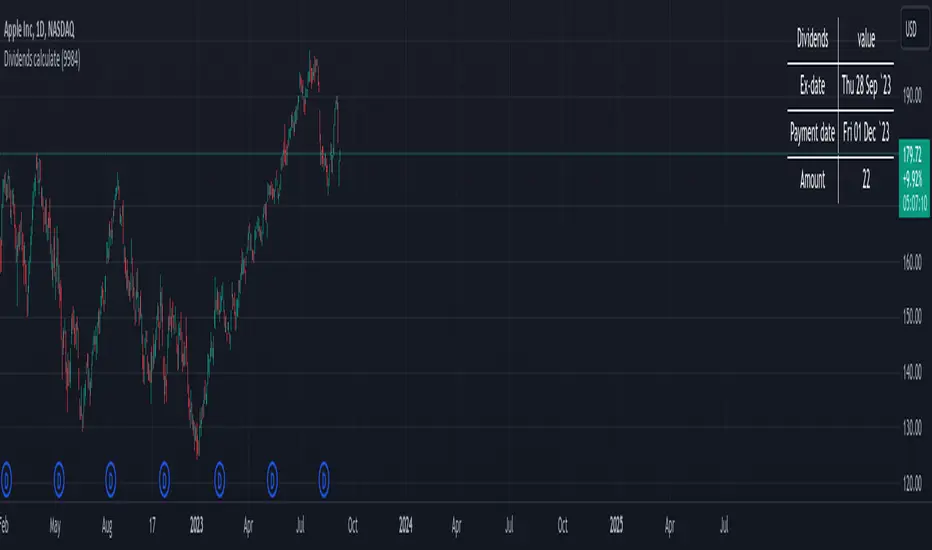
Dividends calculateThe indicator displays the date and amount of future dividends for the selected symbol.
Allows you to forecast the increase in cash volume on the market.
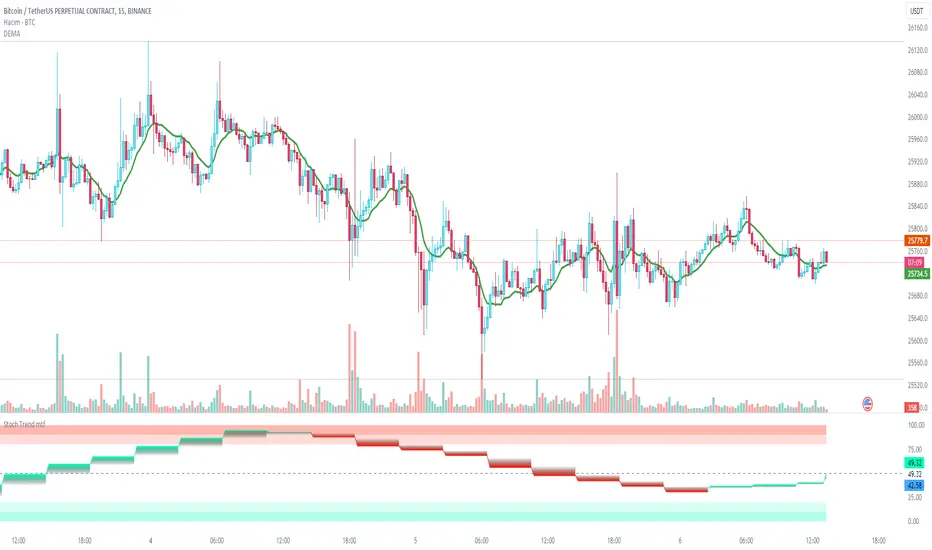
Stochastic Trend mtfDefinition
The Stochastic RSI indicator (Stoch RSI) is actually an indicator of an indicator. It is used in technical analysis to provide a stochastic calculation to the RSI indicator. This means it's an RSI measure relative to its own high/low range over a user-defined time period. Stochastic RSI is an oscillator that calculates a value between 0 and 1 and then plots it as a line. This indicator is primarily used to identify overbought and oversold conditions.
It is important to remember that the Stoch RSI is an indicator of an indicator that is two steps away from the price. The RSI is one step away from the price and therefore a stochastic calculation of the RSI is two steps away. This is important because as with any indicator that is more than one step away from price, the Stoch RSI can be short-term disconnected from actual price action. However, as a range-bound indicator, the Stoch RSI's primary function is to identify cross-bought, overbought and oversold conditions.
Use
When we integrate it into our chart in the upper time frame, it both gives the direction of the trend more healthy and is more efficient in terms of noise reduction in terms of leaving the overbought-sold zones. Unlike the classic stochastic, I set the "d" value to 8. Even though the trend returns are a little late, we see healthier data on our graph. Trend changes in overbought zones are getting stronger. Coloring red indicates that the trend is selling, while painting green indicates that the trend is buying. I hope you find it useful, if you have any questions or suggestions, please feel free to ask.
Good luck...
It is not investment advice.
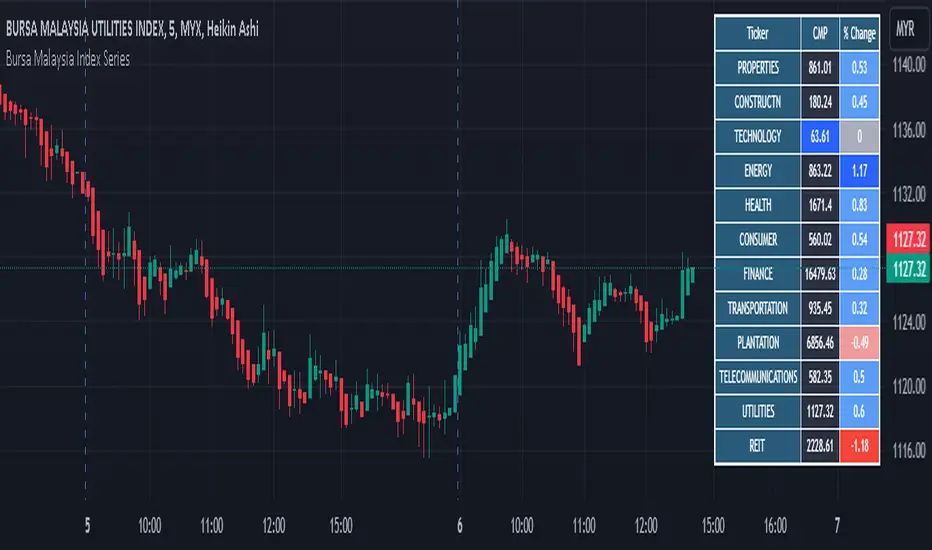
Bursa Malaysia Index SeriesBursa Malaysia Index Series. The index computation is as follows:-
Current aggregate Market Capitalisation/Base Aggregate Market Capitalisation x 100.
The Bursa Malaysia Index Series is calculated and disseminated on a real-time basis at 60-second intervals during Bursa’s trading hours.
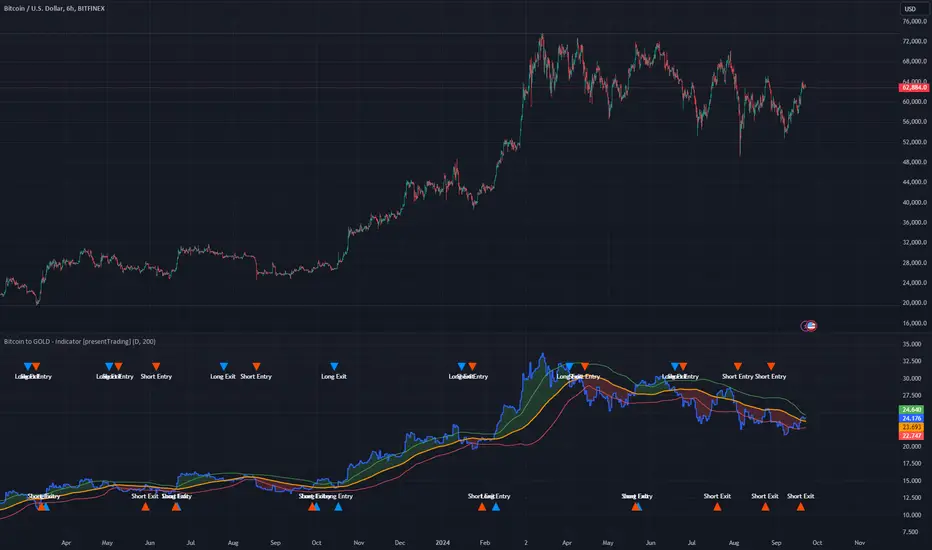
Bitcoin to GOLD [presentTrading]**Introduction and How it is Different**
Unlike traditional indicators, the BTGR offers a unique perspective on market sentiment and asset valuation by juxtaposing two seemingly disparate assets: Bitcoin, the digital gold, and Gold, the traditional store of value. This article introduces an advanced version of this ratio, complete with upper and lower bands calculated using standard deviations. These bands add an extra layer of analytical depth, allowing for more nuanced trading strategies.
BTCUSD 12h bigger picture
**Economic Principles**
The BTGR is rooted in the economic principles of asset valuation and market sentiment. Gold has long been considered a safe haven asset, a place where investors park their money during times of economic uncertainty. Bitcoin, on the other hand, is often viewed as a high-risk, high-reward investment. By comparing the two, the BTGR provides insights into the broader market sentiment.
- Risk Appetite: A high BTGR indicates a bullish sentiment towards riskier assets like Bitcoin.
- Market Uncertainty: A low BTGR suggests a bearish sentiment and a flight to the safety of Gold.
- Asset Diversification: The BTGR can be used as a tool for portfolio diversification, helping investors balance risk and reward.
**How to Use It**
Setting Up the Indicator
- Platform: The indicator is designed for use on TradingView.
- Time Frame: A 480-minute time frame is recommended for more accurate signals.
- Parameters: The moving average is set at 200 periods, and the standard deviation is calculated over the same period.
**Trading Signal**
Long Entry: Consider going long when the BTGR crosses above the upper band.
Short Entry: Consider going short when the BTGR crosses below the lower band.
Note: Due to the issue that the number of trading is less than about 100 times, the corresponding strategy is not allowed to publish.
Adjusted Volume - 20 to 18-dayScript based off the definition Adjusted Volume means the sum of trading volume for a period of 20 consecutive trading days ending on the day preceding the date of determination; provided, however, that the day with the highest volume and the day with the lowest volume shall be eliminated and only the remaining 18 days summed.

FVG w/ Fibs [QuantVue]The "FVG w/ Fibs" indicator is a trading tool designed to identify and visualize Fair Value Gaps (FVGs) while overlaying two Fibonacci retracement levels.
• Bullish FVG: Occurs when the low of the current bar is higher than the high of two bars ago, and the previous close is higher than the high of two bars ago.
• Bearish FVG: Occurs when the high of the current bar is lower than the low of two bars ago, and the previous close is lower than the low of two bars ago.
The indicator filters these gaps based on user-defined criteria such as the minimum percentage size of the gap.
Once identified, these FVGs are highlighted on the chart using customizable boxes and the 50% and 61.8% (default settings) Fibonacci retracement levels are calculated and drawn based on the size of the identified FVG.
• Dynamically updates and extends the boxes as the price evolves.
• Alerts / visual changes for FVGs that get filled.
• User option for fills by Wicks or Close
• User-customizable settings for box colors, styles, and Fibonacci level appearances
Give this indicator a BOOST and COMMENT your thoughts!
We hope you enjoy.
Cheers!

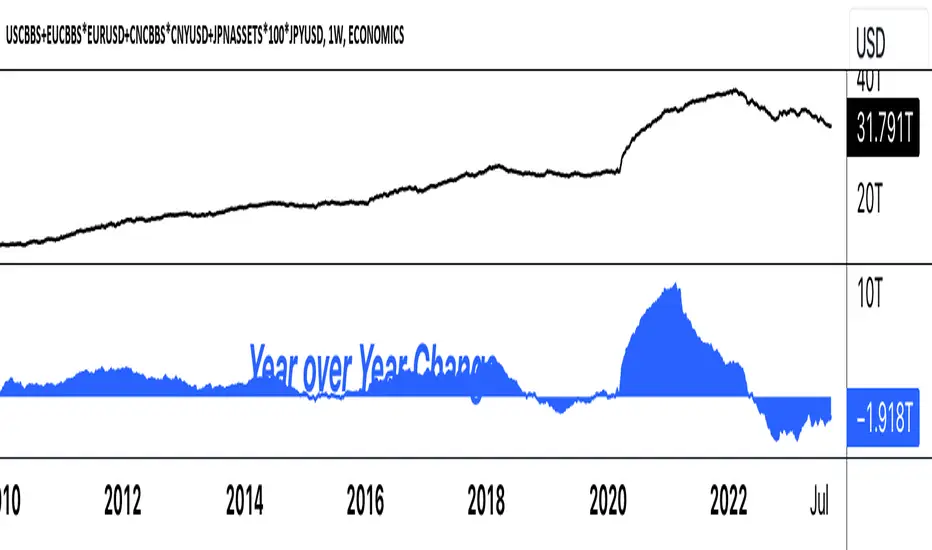
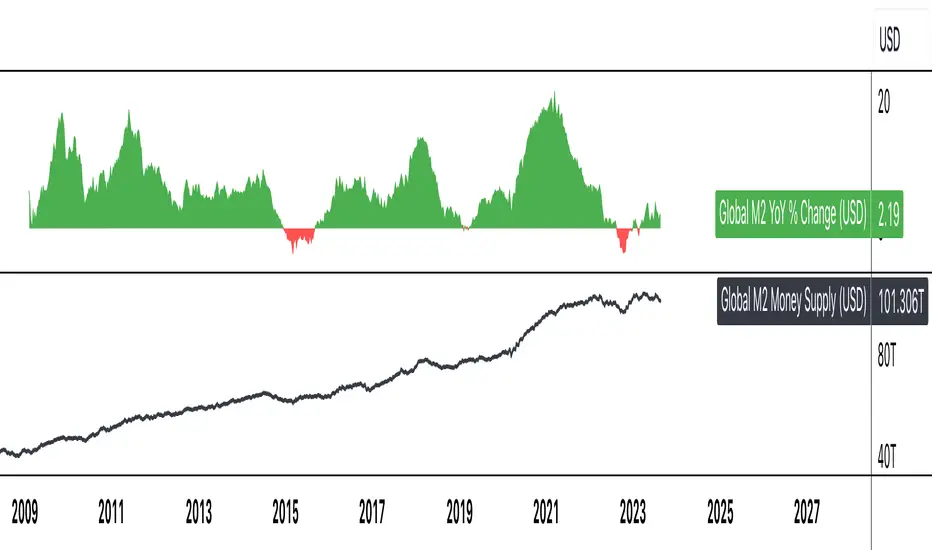
Global M2 YoY % Change (USD)M2 Global Money Supply in USD terms for nations with historical available past ~10 years, year over year % change.

Global M2 Money Supply (USD)M2 Global Money Supply in USD terms for nations with historical available past ~10 years.
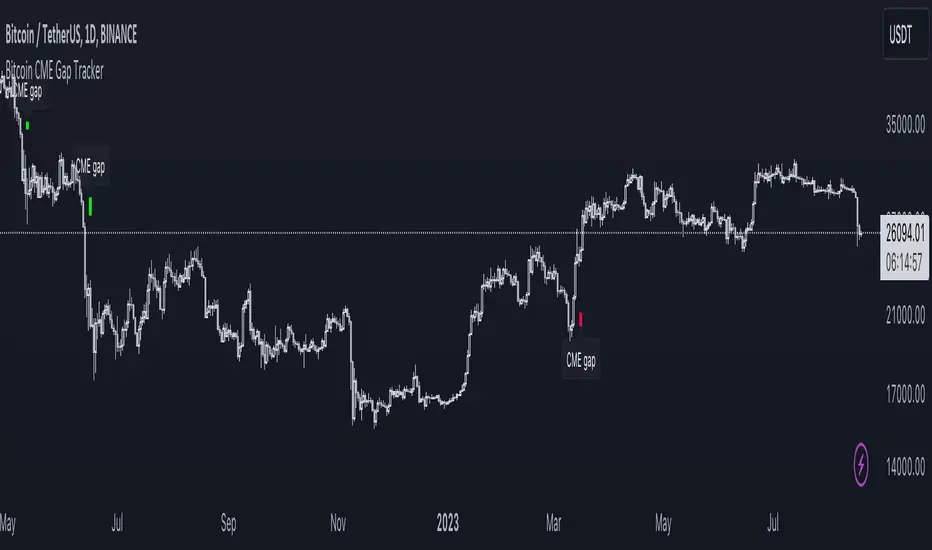
Bitcoin CME Gap TrackerCME Bitcoin Futures Gaps: What Are They and Why Are They Important?
Gaps are breaks between price candles on charts, illustrating the intervals between the closing price of the previous period and the opening price of the next. For Bitcoin on CME, these gaps arise due to the particular workings of this market.
Bitcoin and other cryptocurrencies trade 24/7 without breaks. However, CME Bitcoin Futures, like many other financial instruments on traditional exchanges, have weekends and trading pauses. When the Bitcoin market continues to move during weekends or CME closures, and then CME opens on the subsequent trading day, a price disparity can occur, perceived as a gap.
Several studies suggest that in most cases (approximately 70% and more), the market reverts to "close" these gaps. This phenomenon is observed because large liquidity is concentrated at these gap points. There are many unfilled orders in gap zones, placed at specific prices. When the price reaches these levels, it can swiftly react to this "clustering" of orders, potentially leading to the gap's closure.
Therefore, CME Bitcoin Futures gaps not only reflect crucial psychological moments in the market but can also serve as potential entry or exit points, considering the high liquidity in these zones.
Technical Description:
The script is designed to identify gaps in the Bitcoin Futures chart on CME. It automatically detects gaps that appear on Mondays (since CME is closed on weekends) and are larger than the user-specified percentage.
Key Features:
Identification of the weekday to detect gaps that arose on Monday.
Calculation of positive and negative gaps by comparing the highs and lows of the previous candles with the current ones.
Graphical representation of the gaps using lines and labels on the chart.
User Guide:
Add this script to your TradingView chart.
You can adjust the "Show gaps larger than %" parameter to determine the minimum gap size of interest.
Gaps will be automatically displayed on your chart with lines and labels.