FOMC Sweep Reaction AP Capital – FOMC Sweep Reaction v1.0
AP Capital – FOMC Sweep Reaction v1.0 is a news-reaction and liquidity-based trading tool designed specifically to track and trade FOMC volatility on Gold (XAUUSD) and other highly reactive instruments.
The indicator focuses on liquidity sweeps, structure breaks, and EMA reclaims that commonly occur around Federal Reserve interest-rate decisions and Powell speeches, helping traders identify high-probability reversal or continuation moves after the initial spike.
🔍 What This Indicator Detects
This tool highlights the most repeatable FOMC behaviours observed across multiple months of broker data:
• Sweeps of previous day’s high or low
• Stop-hunt wicks into liquidity pools
• EMA13 reclaim after the news spike
• Break and close beyond short-term structure
• Momentum shift following volatility exhaustion
The goal is not to predict the news, but to react to confirmed price behaviour after liquidity has been taken.
📌 Core Features
• FOMC Sweep Detection
Identifies aggressive wicks into prior highs/lows during news volatility
• EMA Reclaim Confirmation
Uses EMA13 to validate momentum shift after the sweep
• Market Structure Awareness
Filters reactions that fail to break structure to avoid false reversals
• Session-Aligned Logic
Designed around London → NY → FOMC release timing
• Clean Visuals
Minimal chart clutter for fast decision-making during volatile conditions
🧠 How to Use
Wait for FOMC release / Powell speech
Allow price to sweep previous liquidity (PDH / PDL / local extremes)
Observe reclaim of EMA13
Enter only after structure confirmation
Manage trade using EMA trailing or structure-based exits
⚠️ This is a reaction system, not a prediction tool.
📊 Best Use Cases
• XAUUSD (Gold)
• NASDAQ / US indices
• High-impact macro news events
• 5-min to 15-min timeframes
⚠️ Important Notes
• News volatility is extreme — risk management is essential
• Not designed for low-volatility or ranging markets
• Best combined with a clear trading plan and strict risk rules
📎 Disclaimer
This indicator is for educational purposes only and does not constitute financial advice. Trading during high-impact news events involves significant risk.
Candlestick analysis


Zee's A+ MOMO BreakThis just shows an indicator when you have a 5 minute momentum candle that breaks PMH under specific parameters, i.e candle size, wick size, relative volume, time of day, etc. It will plot the PMH with a gold line automatically. Entry would be at the close of the MOMO break. I highly encourage you to back test your results and see how strong this setup is. Any questions feel free to comment or reach out, thanks.

Double/Triple Tops & Bottoms & Rectangle BoxesThis indicator is an algorithmic pattern recognition tool designed to automatically identify, validate, and track significant reversal structures—specifically Double/Triple Tops and Bottoms. Unlike subjective drawing tools, this script uses a strict set of quantitative rules based on swing pivots and volatility (ATR) to define market structure.
The Logical Methodology The script operates on a three-stage "scientific" detection process:
Pivot Chaining (Level Detection): The algorithm scans for significant swing highs and lows using a user-defined lookback period. It stores these pivot levels and monitors subsequent price action. If price returns to a previous pivot level within a specific volatility threshold (normalized by ATR), it registers a "touch."
Pattern Construction (Neckline Identification): Once a level has been touched the required number of times (e.g., 2 for Double patterns, 3 for Triple patterns), the script calculates the "Neckline."
For Tops: It identifies the lowest trough between the peaks.
For Bottoms: It identifies the highest peak between the valleys. This creates a valid trading range, visualized as a blue box connecting the pivot level to the neckline.
Signal Validation (Breakout vs. Failure): The pattern remains in a "pending" state until a breakout occurs.
Confirmation: A signal is generated only when a candle closes beyond the neckline (below for Tops, above for Bottoms).
Invalidation: If price breaks the pivot level itself (e.g., makes a higher high on a Double Top) before breaking the neckline, the pattern is immediately marked invalid to prevent false signals.
Key Features
ATR-Based Sensitivity: Uses Average True Range to dynamically adjust how "precise" a re-test must be, adapting to changing market volatility.
Dual-Scanning: Can independently scan for Triple Tops (Bearish) and Double Bottoms (Bullish) simultaneously with separate settings.
Time & Width Constraints: Filters out "noise" by enforcing a minimum pattern width (in bars), ensuring only structurally significant patterns are displayed.
Settings Guide
Min Top/Bottom Touches: Set to 2 for Double patterns or 3 for Triple patterns.
Pivot Lookback: The number of bars used to define a swing point (higher = larger, more significant patterns).
Touch Sensitivity: Adjusts how strictly the price must match the previous level.
Min Pattern Width: Prevents the detection of micro-patterns that are too narrow to be reliable.

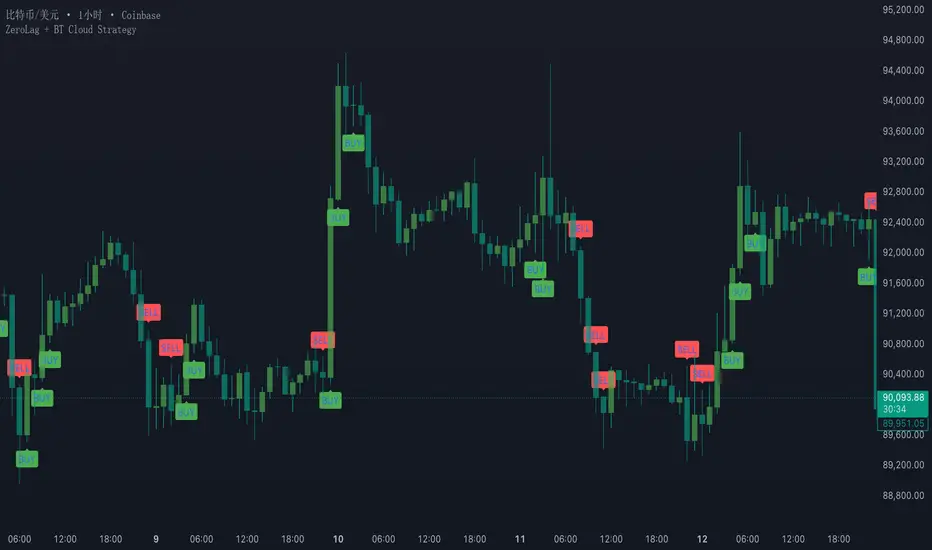
zhanzhang6
Script Name: Zero Lag Trend Signals (MT5)
Description:
A high-sensitivity trend-tracking tool optimized for crypto and stock markets. It eliminates lag in price signals via advanced filtering, generating clear long/short prompts (marked by colored blocks) aligned with market momentum. Suitable for intraday and swing trading—works with all timeframes, with adjustable sensitivity to fit different asset volatilities.
zhanzhang6666
Script Name: Zero Lag Trend Signals (MT5)
Description:
A high-sensitivity trend-tracking tool optimized for crypto and stock markets. It eliminates lag in price signals via advanced filtering, generating clear long/short prompts (marked by colored blocks) aligned with market momentum. Suitable for intraday and swing trading—works with all timeframes, with adjustable sensitivity to fit different asset volatilities.

zhanzhang666Crypto: RSI (overbought/oversold), MACD (trend), Bollinger Bands (volatility), Volume (trend validity), EMA/SMA (trends), RSI Divergence (reversals), Fibonacci (support/resistance), Stochastic (extremes).
• US Stocks: EPS (profit), P/E (valuation), MACD/RSI (trend/overbought), Volume (movement strength), SMA/EMA (trends), ADX (trend strength), Bollinger Bands (volatility), Dividend Yield (returns), ROE (efficiency).

zhanzhang66Key Indicators for Crypto & US Stock Analysis
These indicators are vital for crypto and US stock trading, aiding in trend identification, overbought/oversold judgment, valuation assessment and reversal signal capture, supporting rational trading decisions.
Crypto Indicators
• RSI: Measures price strength to spot overbought/oversold conditions.
• MACD: Tracks trend direction and momentum, capturing reversal signals.
• Bollinger Bands: Gauges price volatility and potential breakouts.
• Volume: Verifies trend validity and market liquidity.
• EMA/SMA: Identifies short/long-term trend directions.
• RSI Divergence: Warns of potential trend reversals.
• Fibonacci Retracement: Predicts key support/resistance levels.
• Stochastic Oscillator: Pinpoints extreme overbought/oversold states.
US Stock Indicators
• EPS: Reflects company profitability, a core fundamental metric.
• P/E Ratio: Evaluates stock valuation rationality.
• MACD/RSI: Tracks trend, momentum and overbought/oversold conditions.
• Volume: Confirms price movement strength.
• SMA/EMA: Clarifies short/long-term trends.
• ADX: Measures trend strength to avoid sideways market trades.
• Bollinger Bands: Judges volatility and breakout directions.
• Dividend Yield: Key for value investors, showing stable returns.
• ROE: Assesses company profit efficiency for long-term investment.


Single Candle Divergence E.V//AMarks single‑candle divergences between the asset on your chart and any user‑selectable second asset, displaying the second asset’s full OHLC candles in a dedicated separate panel.

Seasonality Calculator Custom Date Range AnalysisThe Seasonality Calculator lets you manually test any seasonal window by choosing a start day/month and end day/month, and then evaluating how that exact period performed historically.
For the selected date range, the script looks back over past years and calculates:
Average return
Hit rate (win rate)
Winning years vs. total years
The results are displayed in a compact on-chart table showing:
Entry date & exit date (calendar days)
Pattern length
Average return & hit rate
Win/trade count
Optionally, the indicator can also draw highlighted boxes for each year of the chosen seasonal window, so you can visually inspect how that specific date range behaved in the past.
You can:
Choose the exact start and end dates (day & month),
Set how many years of history to include,
And filter by simple regimes such as US election cycle years.
All calculations are based on daily data, and the math is consistent with the Seasonality Screener: if you take a pattern from the Screener and enter the same dates into this Calculator, you will get the same historical statistics.
Use this tool to experiment with custom seasonal ideas and to fine-tune windows you discover with the Screener, always in combination with your own analysis and risk management.

Seasonality Screener Best Long & Short Patterns Auto-ScanThe Seasonality Screener automatically scans a market’s history to find the most profitable seasonal patterns in the days ahead.
It searches for both long and short setups and shows you the two best patterns based on historical performance.
For each pattern, the screener looks back over past years and calculates:
Average return
Hit rate (win rate)
Winning years vs. total years
The results are displayed in a compact on-chart table with:
Entry date & exit date (calendar days)
Pattern length
Average return & hit rate
Win/trade count
Optionally, the indicator can also draw highlighted boxes in the chart’s history for the selected long and/or short pattern, so you can visually inspect how the seasonal window performed in each year.
You can:
Define how far ahead the screener should look (e.g. next X days),
Control the minimum and maximum pattern length,
Choose how many years of history to use,
And filter by simple regimes such as US election cycle years.
Internally, all calculations are based on daily data, so the seasonal analysis has to be done on the daily timeframe.
This tool is designed as a research and idea generator for seasonal tendencies and should be used together with your own risk management and trading plan.

ShayanFx XAU M5 This indicator starts working at 8 am New York market time and you have 3 hours to get signals from it.
We enter a trade on any candle that gives a signal. We place the stop loss behind the same candle and take a reward of 2.
We are not allowed to take more than 2 trades during the day. If the first trade is closed with profit, we will not open another trade, but if the first trade is closed with loss, we are allowed to take another signal.

Sessions CET Asia, London, New YorkThis indicator displays the Asia, London, and New York trading sessions in CET time.
Each session is shown with a background highlight and optional labels, making it easy to visualize global market activity and session overlaps.
Useful for intraday traders, breakout strategies, liquidity analysis, and volume-based setups.
Features:
Correct session times adjusted to CET
Visual background zones for Asia, London, New York
Clean layout, minimal visual noise
Supports any timeframe
Helps identify volatility peaks, session opens, and market structure shifts

[Yorsh] BJN iFVG Model BJN iFVG Model - Mechanical Trading System
Description:
The BJN iFVG Model is not just an indicator; it is a full-scale, semi-automated trading architecture designed to mechanically execute the specific "BJN" Inverted FVG strategy.
Designed for precision traders operating on Lower Timeframes (1m to 5m), this script eliminates the cognitive load of manual analysis. It automates every single step of the mechanical model—from Higher Timeframe narrative building to tick-perfect structural validation and risk calculation.
This tool transforms your chart into a professional trading cockpit, split into three intelligent engines:
1. The Matrix (Context Engine)
Before looking for an entry, you must understand the narrative. The Matrix handles the heavy lifting of multi-timeframe analysis without cluttering your chart:
Real-Time Delivery State: Automatically detects if price is reacting from valid HTF PD Arrays (1H, 4H, Daily) to confirm a "Delivery" state.
Liquidity Sweeps: Tracks Fractals across three dimensions (1H, 15m, and Micro-Structure) to identify liquidity raids instantly.
Advanced SMT Divergence: A built-in, multi-mode SMT engine scans for correlation breaks (Pivot SMT, Adjacent Wick SMT, and FVG SMT) between NQ/ES (or custom tickers) in real-time.
Time & Macro Tracking: Automatically visualizes Killzones and highlights high-probability Macro windows.
2. The Executioner (Entry Engine)
Once the context is set, the Executioner handles the specific Inverted FVG (iFVG) entry model with strict mechanical rules:
Structural Integrity: Automatically identifies the Invalidation Point (IP), Floor/Ceiling, and Break-Even levels for every setup.
Hazard Detection: The script proactively scans the "Trading Leg" for opposing unmitigated FVGs (Hazards). If the path isn't clean, the trade is flagged or invalidated.
Composite Logic: Intelligently merges "noisy" price action into Composite FVGs to reduce false signals.
Integrated Position Sizer: When a trade is confirmed, a visual box appears showing your precise Entry, Stop Loss, Hard Stop, and Take Profit levels, along with a calculated Contract Quantity based on your risk tolerance.
3. The Ranking System (Quality Control)
Not all trades are created equal. This system grades every single confirmed setup in real-time based on confluence factors:
Grades: Ranges from A++ (Perfect Confluence) to C (Low Probability).
Confluence Check: Checks for Delivery, Sweeps (HTF/LTF), SMT, and Macro alignment at the exact moment of the trigger.
Live Status Panel: A dashboard on your chart displays the current live trade status (Armed, Triggered, Confirmed) and its Rank, so you never miss a beat.
Optimization & Performance
Trading on the 1-minute timeframe requires speed. This script has been rigorously optimized for high-frequency environments:
Smart Garbage Collection: The script manages its own memory, cleaning up old data arrays to prevent lag, ensuring the chart remains fluid even after days of data accumulation.
Tunnel Vision: Calculations are strictly focused on the relevant trading leg, ignoring historical noise to maximize execution speed.
Zero-Repaint: All historical analysis is strictly non-repainting to ensure backtesting reliability.
How to Use
Timeframes: Optimized for 1m, 2m, 3m, 4m, 5m execution.
Alerts: Configure the robust alert system to notify you only when setups meet your standards (e.g., "Alert only on Rank B+ or higher").
Strategy: Wait for the Status Panel to show a "CONFIRMED" signal. Use the on-screen Position Sizer to execute the trade with the displayed risk parameters.
Stop analyzing; start executing. Welcome to mechanical trading.
----------------------------------------------------------------------------------------------------------------
RISK DISCLAIMER:
The content, tools, and signals generated by this script are strictly for educational and informational purposes only. This script does not constitute financial advice, investment recommendations, or a solicitation to buy or sell any securities, futures, or other financial instruments.
Trading financial markets involves a high degree of risk and is not suitable for all investors. The "Position Sizer" and "Trade Setups" displayed are hypothetical simulations designed to demonstrate the mechanics of the BJN methodology; they do not guarantee future performance.
Use this tool at your own risk. The author assumes no responsibility or liability for any trading losses or damages incurred in connection with the use of this script. Always consult with a qualified financial advisor and practice proper risk management.

Impulse %Impulse % — Liquidation Cascade Detector (BTC · 1H)
Impulse % identifies sharp impulsive price moves and liquidation cascades by measuring how much a candle’s range deviates from its historical average in percent.
How it works
Calculates the candle range (in %) relative to price and compares it to the average over N periods.
When the range exceeds the upper band, an Impulse is detected.
Inside each 1H candle, the indicator checks lower timeframes (1m / 5m) to classify the impulse phases:
PANIC — the first minutes of a violent move (forced liquidations, stop hunts).
CAUTION (Cascade) — continuation and “cleanup” phase with elevated risk.
Determines whether the impulse is against the trend using EMA 50 / EMA 200 — the most dangerous scenario.
Highlights risk zones to protect positions and filter new entries.
What it’s for
Avoid entering during liquidation cascades.
Exit at break-even or partially take profit during risky phases.
Recommended Settings — BTC (1H)
Calculation
Calculation TF: (empty = current)
Average Mode: By N bars
N (bars): 100
Range Type: High–Low
Bands
Upper Band (% of average): 130
Lower Band: Auto (same %)
Cascade (First Minutes)
Enable Cascade Filter: ON
When to trigger safety: Only against trend
PANIC (minutes): 3
CAUTION (minutes after PANIC): 15
Trend (EMA)
Use EMA Trend: ON
Fast EMA: 50
Slow EMA: 200
Lower TF Detection
Lower TF: 1m (or 5m if you prefer smoother signals)
Visualization
Style: Columns
Show Bands: ON
Show Band Lines & Mean: ON
How to read it (BTC · 1H)
Purple (PANIC): first minutes of liquidation — do not enter.
Yellow (CAUTION): cascade phase — high risk, manage/exit.
Normal color: no active cascade — strategy allowed.
Best practice:
1m/5m → real-time cascade detection
1H → decision level
4H → market context

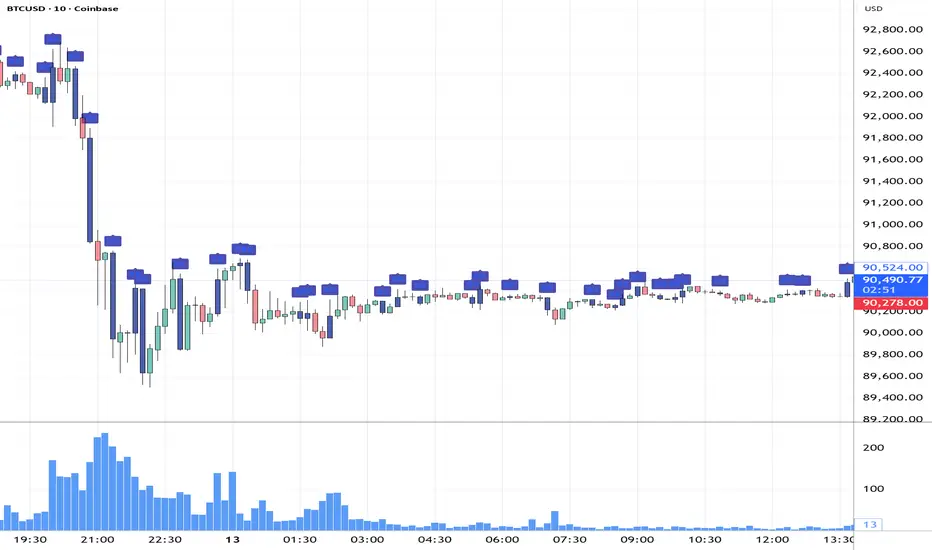
Trend zooming boxThis script clearly find trend.
You will be able to find areas where you get large impulsive moves in history easily. Not too much to describe.

Victor aimstar past strategy -v1Introducing the ultimate all-in-one DIY strategy builder indicator, With over 30+ famous indicators (some with custom configuration/settings) indicators included, you now have the power to mix and match to create your own custom strategy for shorter time or longer time frames depending on your trading style. Say goodbye to cluttered charts and manual/visual confirmation of multiple indicators and hello to endless possibilities with this indicator.
What it does
==================
This indicator basically help users to do 2 things:
1) Strategy Builder
With more than 30 indicators available, you can select any combination you prefer and the indicator will generate buy and sell signals accordingly. Alternative to the time-consuming process of manually confirming signals from multiple indicators! This indicator streamlines the process by automatically printing buy and sell signals based on your chosen combination of indicators. No more staring at the screen for hours on end, simply set up alerts and let the indicator do the work for you.

Nooner's Heikin-Ashi/Bull-Bear CandlesCandles are colored red and green when Heikin-Ashi and Bull/Bear indicator agree. They are colored yellow when they disagree.

ICT Macro Tracker - Study Version (Original by toodegrees)This indicator is a modified study version of the ICT Algorithmic Macro Tracker by toodegrees, based on the original open-source script available at The original indicator plots ICT Macro windows on the chart, corresponding to specific time [ periods when the Interbank Price Delivery Algorithm undergoes checks/instructions (aka "macros") for the price engine to reprice to an area of liquidity or inefficiency.
This study version adds functionality to hide bars outside macro periods. When enabled, the indicator draws boxes that cover the full chart height during non-macro periods, obscuring those bars so only macro periods are visible. This helps focus on macro-only price action. The feature is configurable, allowing users to enable or disable it and customize the box color. All original functionality remains intact.

