
The 5 Types of Trading Bots Every Trader Should Know
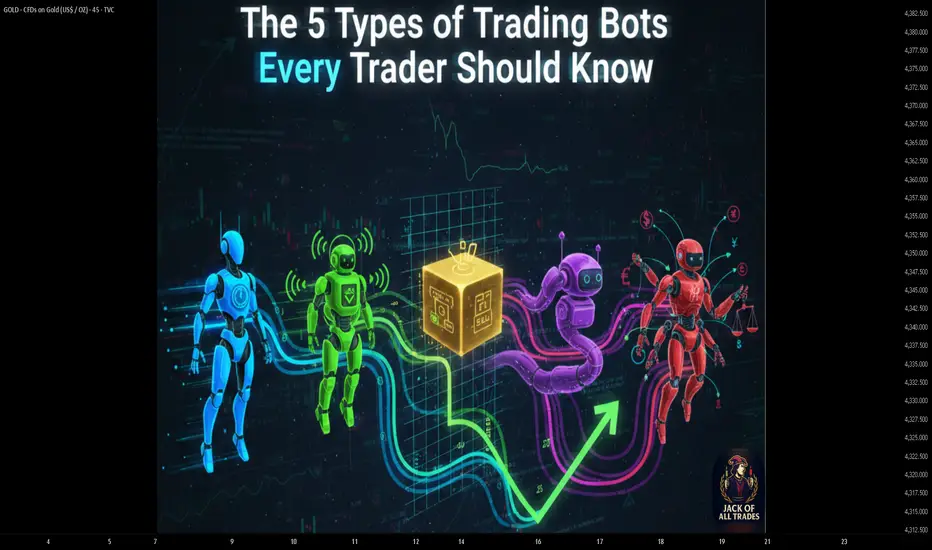
Not All Trading Bots Are the Same - Some Amplify Your Edge, Some Amplify Your Pain
Saying "I want a bot" is like saying "I want a vehicle":
- A Formula 1 car
- A delivery truck
- A scooter
- A helicopter
All are vehicles. None are interchangeable.
In the era of AI‑assisted trading, bots are execution engines for your ideas. This post breaks down five major bot archetypes so you can stop hunting for "the best bot" and start matching the right structure to your market, risk profile, and skill set.
First Cold Truth: Bots Don't Create Edge — They Scale It
Before we talk types, it’s worth being brutally honest:
If your strategy has no edge, a bot just lets you lose money faster, more consistently, and with perfect discipline.
Bots are about discipline, speed, and scalability. The edge still has to come from your logic, testing, and risk framework.
Quick Map of the 5 Bot Types
- Trend‑Following: Ride directional moves, ignore the noise.
- Mean‑Reversion: Fade extremes, bet on snap‑backs.
- Grid: Harvest volatility inside a range.
- Signal‑Based: Turn ideas/alerts into consistent execution.
- Arbitrage: Exploit price differences between related markets.
From here, you want to ask two things: What structure is the market in? and What structure is my brain comfortable with?
Type 1 – Trend‑Following Bots
These bots try to behave like a disciplined trend trader that never hesitates and never gets emotional.
- Core idea: Buy strength in uptrends, sell weakness in downtrends.
- Typical tools:Moving‑average crossovers (fast vs slow)
Breakouts above recent highs or below recent lows
Momentum filters (e.g., ADX, rate of change, volatility filters)
- Shine in: Clean, directional markets where pullbacks are shallow.
- Struggle in: Sideways chop where price crosses the same levels repeatedly.
- Main risk: A long sequence of small whipsaw losses when there is no real trend.
In the AI era, you can use models to classify regimes (trending vs ranging) and only let the trend bot run when the environment actually supports it.
//@version=6
indicator("Simple Trend Filter", overlay=true)
fast = ta.ema(close, 20)
slow = ta.ema(close, 50)
trendUp = fast > slow
trendDown = fast < slow
// Simple visual trend filter
plot(fast, color=color.teal)
plot(slow, color=color.orange)
bgcolor(trendUp ? color.new(color.teal, 90) : trendDown ? color.new(color.orange, 90) : na)
This kind of logic is usually just one piece of a full bot, but it shows how a trend‑following engine "sees" the market.
Type 2 – Mean‑Reversion Bots
Mean‑reversion bots assume that, most of the time, price doesn't drift off to infinity — it oscillates around some reference value.
- Core idea: Fade overextended moves and bet on a return to the mean.
- Typical tools:RSI or Stochastic extremes ("overbought" / "oversold")
Touches or pierces of Bollinger Bands
Deviation from a moving average (z‑score, % distance)
- Shine in: Ranging markets, stable channels, and mean‑reverting pairs.
- Struggle in: Strong trends where "oversold" keeps getting more oversold.
- Main risk: One big runaway move can erase many small wins if sizing and stops are not controlled.
These bots can feel smooth until they don't. AI can help here by measuring when volatility/range structure changes and cutting exposure before that "one big trend" shows up.
Type 3 – Grid Bots
Grid bots are volatility harvesters. They care less about direction and more about price oscillating through pre‑defined levels.
- Core idea: Place a ladder of buy and sell orders above and below price.
- Profit engine: As price bounces through the grid, the bot systematically buys lower, sells higher, and repeats.
- Shine in: Sideways but active markets that revisit levels frequently.
- Struggle in: Strong one‑way moves that blow through the grid and never mean‑revert.
- Main risk: Deep, unrealized drawdowns if price trends hard against the grid without a safety mechanism.
Smart grid design in the AI era often includes:
- Dynamic grid width that widens or tightens based on volatility
- Max drawdown or margin‑usage limits that trigger a partial or full shutdown
- Regime filters that turn the grid off when a strong trend is detected
Type 4 – Signal‑Based Bots
Signal bots don't "think" on their own – they are pure executors. Their job is to turn a human or model‑generated signal into consistent, rules‑based action.
- Core idea: Separate idea generation from order execution.
- Signal sources can include:Multi‑indicator confluence (trend + volume + volatility)
Pattern recognition (breakouts, candle patterns, structures)
Order‑flow or whale‑tracking alerts
On‑chain, macro, or sentiment data for crypto and indices
- Shine in: Any market where the underlying signal logic has been tested and proven.
- Struggle in: Environments where the signal is over‑fitted, delayed, or not monitored.
- Main risk: Blind faith in a black‑box signal without understanding its limits.
This is where AI often plugs in directly – models generate scores or labels, and the bot simply acts when the score crosses a threshold.
Type 5 – Arbitrage Bots
Arbitrage bots focus on relationships instead of single charts. They look for small, temporary mispricings and try to lock them in.
- Core idea: Buy where something is cheap and sell where it's expensive, as close to simultaneously as possible.
- Common approaches:Same asset, different exchanges (spot vs spot or spot vs perp)
Triangular FX arbitrage between three currency pairs
Statistical arbitrage between correlated assets that have diverged
- Shine in: Fragmented, less efficient markets with occasional big gaps.
- Struggle in: Highly efficient markets where spreads and latency competition eat the edge.
- Main risk: Execution risk – slippage, fees, and delays can flip a theoretical "risk‑free" trade into a losing one.
These are the most infrastructure‑heavy bots. Latency, connectivity, fee structure, and capital sizing matter as much as the model itself.
Choosing Your Bot in the AI Era
Instead of asking "Which bot makes the most?", ask:
- What market structure am I actually trading most of the time?
- How much drawdown and variance am I truly comfortable with?
- Am I more aligned with riding trends or fading extremes?
- What is my technical and infrastructure level right now?
- Where can AI realistically help me – signal quality, risk controls, or execution?
AI can support you by:
- Classifying regimes (trend vs range) and routing orders to the right bot type
- Monitoring portfolio‑level risk across multiple bots and symbols
- Detecting when performance degrades and suggesting parameter reviews
But the decision of which bot to run, when to turn it off, and how to size it is still your responsibility.
Your Turn
Which of these five bot types actually fits your temperament and the markets you trade right now?
If you had to upgrade one layer of your automation with AI today - signal generation, risk management, or execution - which one would move the needle the most for you?
Share it below. The clearer you are about what kind of bot you’re running and why, the less you’ll ever have to blame "the bot" when the outcome doesn’t match the plan.

#1 Full Stack AI Trading Community — jackofalltrades.vip | 2026: The Era of AI Trading Mastery📈 AI Automation • AI Trading Bots • Indicators • Strategies • Limitless Potential • Institutional Grade Products • t.me/jackofalltradesvip
คำจำกัดสิทธิ์ความรับผิดชอบ
ข้อมูลและบทความไม่ได้มีวัตถุประสงค์เพื่อก่อให้เกิดกิจกรรมทางการเงิน, การลงทุน, การซื้อขาย, ข้อเสนอแนะ หรือคำแนะนำประเภทอื่น ๆ ที่ให้หรือรับรองโดย TradingView อ่านเพิ่มเติมใน ข้อกำหนดการใช้งาน
#1 Full Stack AI Trading Community — jackofalltrades.vip | 2026: The Era of AI Trading Mastery📈 AI Automation • AI Trading Bots • Indicators • Strategies • Limitless Potential • Institutional Grade Products • t.me/jackofalltradesvip
คำจำกัดสิทธิ์ความรับผิดชอบ
ข้อมูลและบทความไม่ได้มีวัตถุประสงค์เพื่อก่อให้เกิดกิจกรรมทางการเงิน, การลงทุน, การซื้อขาย, ข้อเสนอแนะ หรือคำแนะนำประเภทอื่น ๆ ที่ให้หรือรับรองโดย TradingView อ่านเพิ่มเติมใน ข้อกำหนดการใช้งาน